Trends, Brands and Buyer Insights (2019–2025)
Based on NZTA Motor Vehicle Register Data
Prepared by Mary Hamilton from Wilderness Motorhome Sales
February 2026
1. Executive Summary
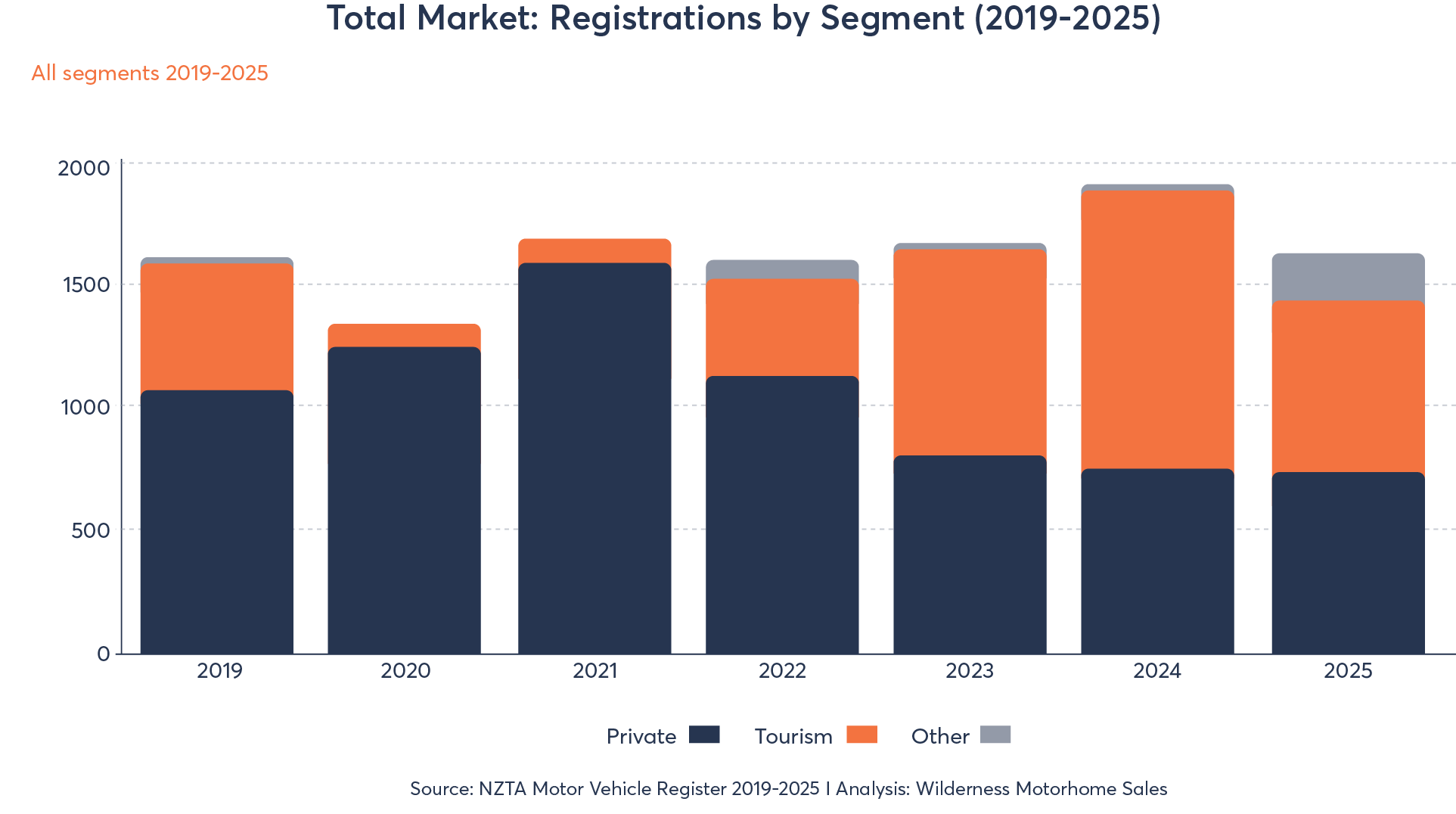
This report presents a comprehensive analysis of the New Zealand motorhome market from 2019 to 2025, drawing on NZTA registration data to identify key trends in market composition, brand performance, platform use, and manufacturing origin. 2025 data shows significant market shifts and provides clarity on patterns of recovery post-COVID.
Key Findings:
-
Total registrations (private & tourism): 11,449 new motor caravanscollective term that encompasses both motorhomes (built on a truck chassis) and campervans (built on a van chassis). registered over seven years, averaging 1,635 units annually. The market peaked in 2024 at 1,904 units, then settled to 1,633 in 2025. Chinese-manufactured LDV platforms captured 12.6% of total 2025 registrations.
-
Private market approaching stabilisation: After four consecutive years of decline, the rate of contraction slowed markedly in 2025 (−1.9%) compared to prior years (−6.3% in 2024, −28.7% in 2023). At 739 units, the private market may be nearing its post-COVID floor.
-
Tourism refleeting complete: Rental fleet registrations normalised to 701 units in 2025 after aggressive 2023–2024 refleeting (1,970 combined), returning toward the pre-COVID baseline of 513.
-
JAYCO leads private sales: Australia’s leading brand captured 16.9% of the known private market in 2025 – up from 10.1% historically – becoming the #1 private brand for the first time.
-
Platform dominance: FIAT Ducato accounts for 50% of private registrations, maintaining its top position in the private market.
-
Market shifts toward higher GVM: New vehicle registrations saw a pronounced shift away from the sub-3,500kg category toward the 3.5–6.0 tonne category, which now dominates at 77% - reflecting the typical weight of coach-builtAn RV where a custom living area (the "coach") is built onto the back of a supplied "chassis-cab." European motorhomes.
-
Australasian shift: For the first time, Australasian-origin motorhomes (37.5% of known private market) have overtaken European sources, driven by JAYCO and NZ-built growth.
2. Introduction
The New Zealand motorhome market has undergone significant shifts between 2019 and 2025, shaped by the COVID-19 pandemic, global supply chain disruptions, changes in consumer behaviour, and broader economic conditions. Initially buoyed by strong domestic demand during border closures, the market saw a surge in registrations in 2020 and 2021. This was followed by a prolonged period of decline as supply constraints took hold and international travel resumed, which reshaped patterns of demand.
Sources and limitations of this report
This report draws on NZTA vehicle registration data to analyse the evolving dynamics of the market, including brand performance, sourcing regions, platform selection, and market segmentation. A key limitation of the data is that vehicle registrations are recorded based primarily on the vehicle platform – the first stage of manufacture. Motorhomes undergo a second stage of manufacturing where a base vehicle is converted into a motorhome by a specialist builder. This second stage is not consistently recorded in registration records.
As a result, important details about the motorhome conversion – such as the brand of the motorhome itself – are often missing. This is particularly problematic for locally built motorhomes, such as those produced by TrailLite, one of New Zealand’s largest private motorhome manufacturers, whose brand name does not appear on compliance plates. Approximately 23% of private market registrations across the seven-year period cannot be attributed to a specific brand.
|
A Note on Terminology
The NZTA classification ‘motor caravan’ is a collective term that encompasses both motorhomes (built on a truck chassis) and campervans (vans converted into mobile living spaces). It may also include a small number of equine transport vehicles and other vehicles that do not fit standard classifications. This report uses ‘motorhome’ as the general term, with ‘campervan’ used specifically where body type distinctions are relevant. |
3. A Brief History of the NZ Motorhome Market
New Zealand’s motorhome industry is rooted in a national love of road trips and outdoor adventure. For generations, Kiwi families have embraced camping as a quintessential summer pastime, spending holidays in tents or caravans set against the country’s stunning natural landscapes. This enduring culture of road travel laid the foundation for New Zealand’s domestic RV industry.
From Caravans to Motorhomes
As camping grew in popularity, caravans became the next evolution. By the 1950s, small-scale caravan manufacturing was booming in towns across New Zealand. Local producers like CI Munro, Jackson Caravans, and Liteweight built robust, practical models. The industry peaked in the 1970s before collapsing in 1979 due to a new luxury tax, from which it never fully recovered.
As caravans waned, motorhomes took off. CI Munro pivoted to motorhome production in the 1970s and was later acquired by Tourism Holdings Ltd (THL) in 1995. Rebranded as Action Manufacturing, it became the country’s largest producer, building for rental brands like maui and Britz. TrailLite, based in Pukekohe, also transitioned from caravan to motorhome production, evolving into New Zealand’s oldest and most established private motorhome manufacturer.
The earliest NZ-built motorhomes were practical and built for rugged conditions—based on underpowered Japanese trucks, carrying over caravan-style layouts with overcab berths and rear club lounges. These features remain common in locally built models today, though European design elements are increasingly influential.
The Rise of Imports and Decline of Local Manufacturing
The most significant transformation in the New Zealand motorhome market has been the shift from locally manufactured vehicles to imports. This transition unfolded over two decades:
-
Pre-2000s: Most motorhomes were built locally by companies like TrailLite, Kea, and various caravan converters. Imports were limited to privately sourced vehicles and converted Japanese buses.
-
Early 2000s: New Zealand’s strong dollar and reduced import barriers made European models attractive. Compact, efficient layouts and modern fit-outs drew consumer interest.
-
2004–2012: European brands like Benimar, Roller Team, and Bürstner grew rapidly. UK-built Swift and Auto-Trail models became popular with retirees. NZ manufacturers struggled to compete on price and volume.
-
2015–2020: Imports dominated the majority of new registrations. Many smaller local manufacturers closed, unable to compete with international scale and pricing.
-
2020–2022: COVID-era supply disruptions caused a temporary return to local builds as THL expanded NZ-based production. Demand for used motorhomes surged.
-
2023–present: Imports returned as supply chains recovered. The market now reflects a diverse mix of European, Australian, UK, and NZ-built motorhomes.
Today, Action Manufacturing (THL) and TrailLite remain the standout local producers in a landscape dominated by international brands. Boutique NZ manufacturers, including ACM Motorhomes, Tranztec RV, ALM Group (Allisee), Coastal Motorhomes, and Explorer Motorhomes, continue to serve niche segments with bespoke and premium builds.
4. Private Market Analysis
Market Trajectory: Approaching Stabilisation
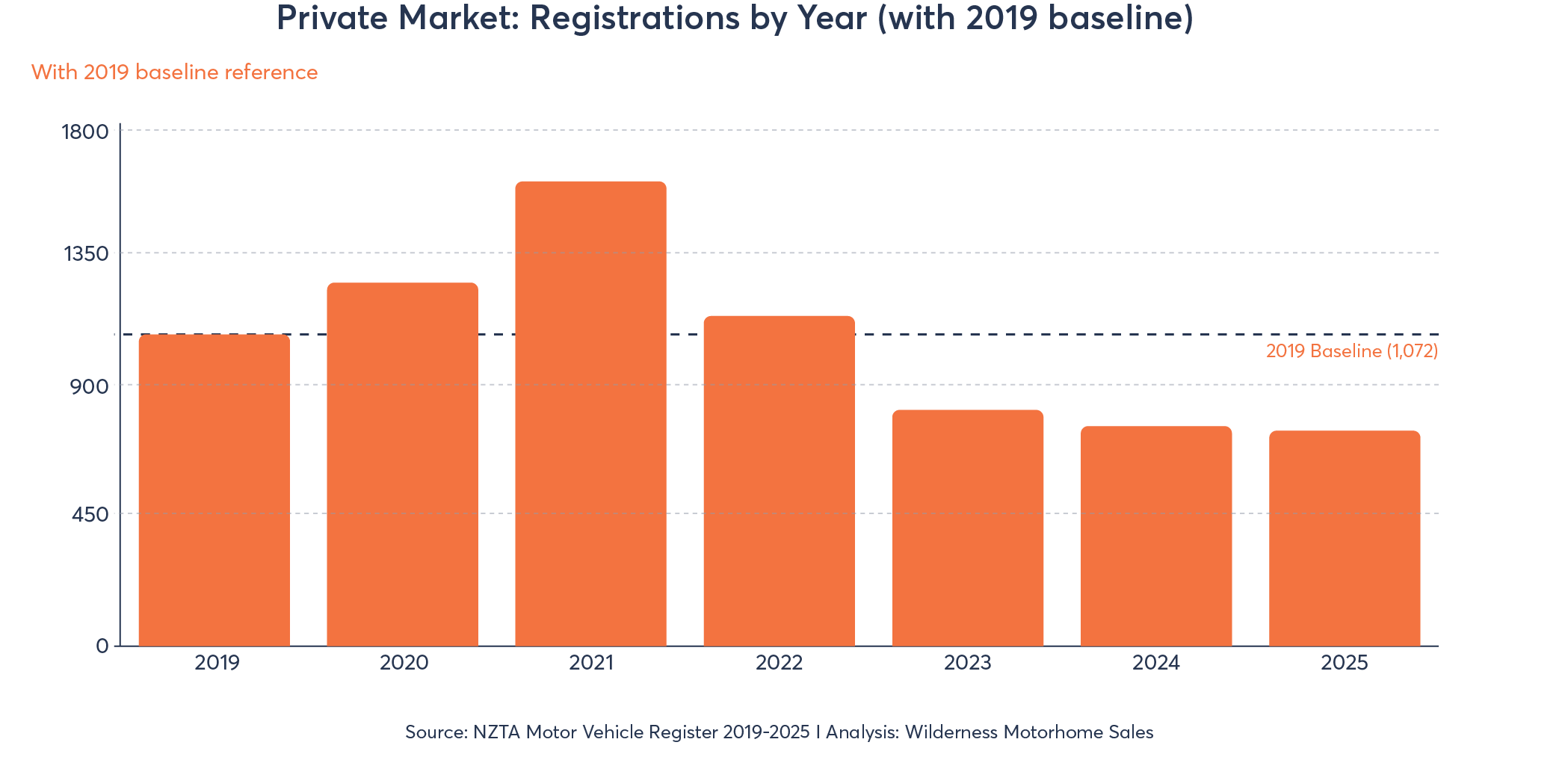
The private market recorded 739 new registrations in 2025, representing a 1.9% decline from 2024’s 753 units. While this marks the fifth consecutive year of decline since 2021’s peak of 1,597 units, the rate of contraction has slowed dramatically – from -29.4% (2022), to -28.7% (2023), to -6.3% (2024), to just -1.9% in 2025. This deceleration suggests the market may be approaching its post-COVID floor.
The 2025 figure remains 31.1% below the 2019 baseline of 1,072 units. The seven-year average of 1,048 private registrations annually indicates the current level represents a significant contraction from historical patterns.
COVID Impact Analysis: Surplus Fully Absorbed
Using 2019 as the baseline year (1,072 new registrations), the COVID surplus period of 2020–2022 generated 754 units above baseline. This showed a pull-forward demand as locked-down consumers invested in domestic travel. The subsequent deficit period of 2023–2025 saw 920 units below baseline as the market worked through the surplus and faced economic headwinds. The net position at the end of 2025 stands at 166 units below the cumulative baseline, indicating the payback period is complete and then some.
|
Year |
Private |
Variance vs Baseline |
Cumulative |
Period |
|
2019 |
1,072 |
0 |
0 |
Baseline |
|
2020 |
1,246 |
+174 |
+174 |
Surplus |
|
2021 |
1,597 |
+525 |
+699 |
Surplus |
|
2022 |
1,127 |
+55 |
+754 |
Surplus |
|
2023 |
804 |
−268 |
+486 |
Deficit |
|
2024 |
753 |
−319 |
+167 |
Deficit |
|
2025 |
739 |
−333 |
−166 |
Deficit |
Table 2: Private market COVID surplus/deficit analysis (baseline = 2019)
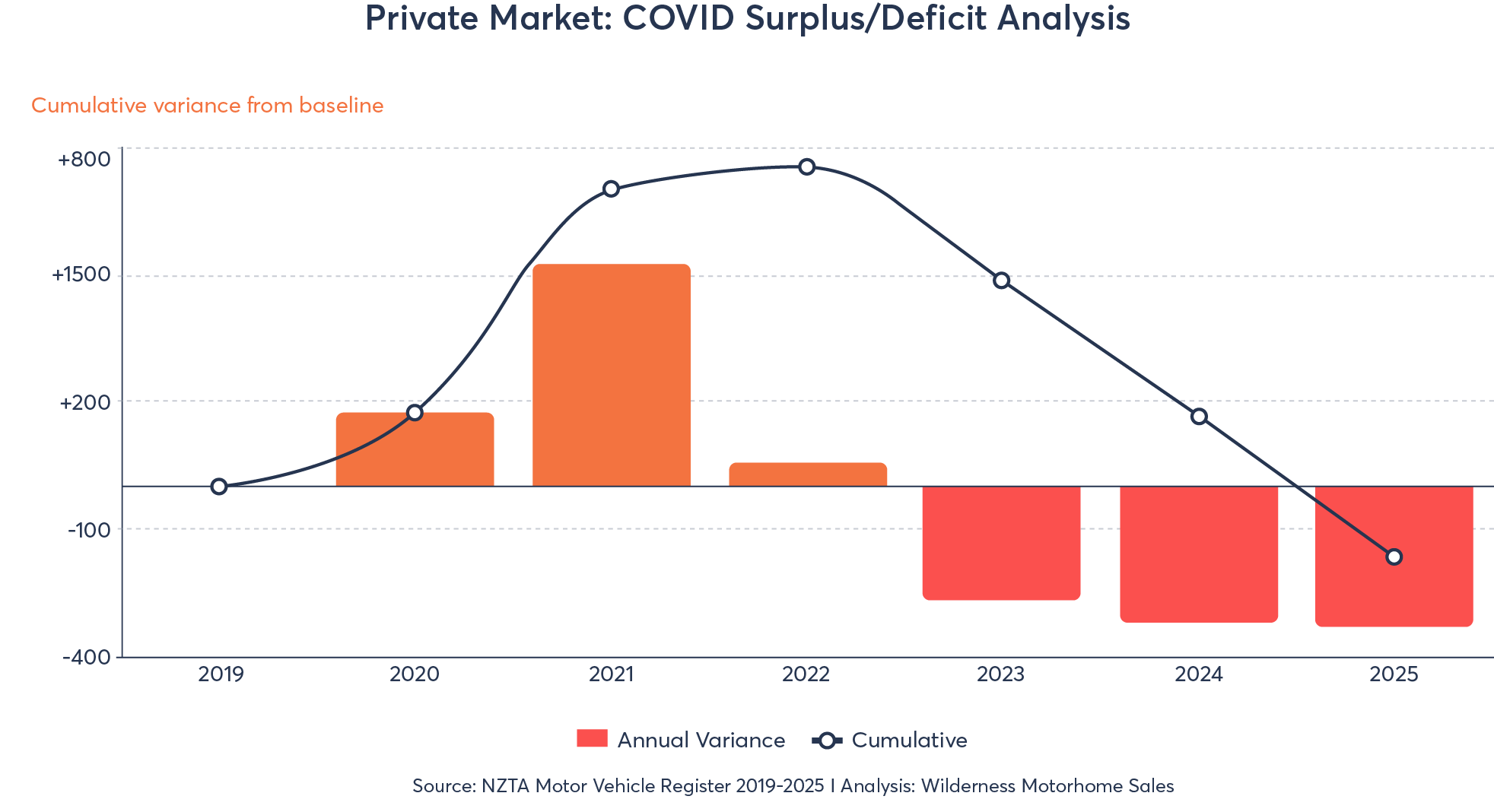
This analysis suggests 2026 should see continued stabilisation, with annual registrations potentially recovering toward 800–1,000 units over the medium term.
Brand Performance: 2025 Reshapes the Leaderboard
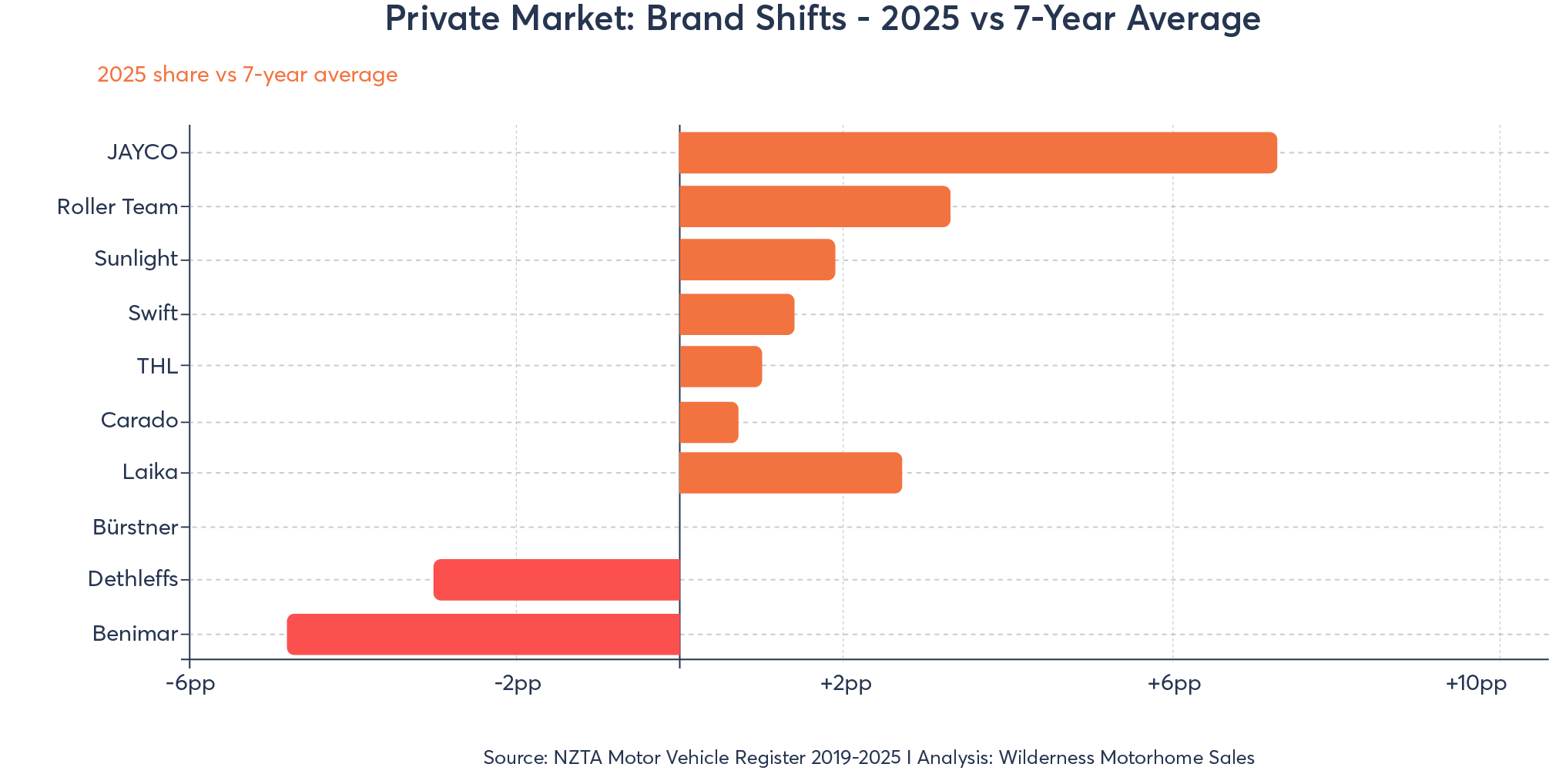
The 2025 data reveals significant shifts in brand rankings, with JAYCO emerging as the dominant private brand for the first time. The following analysis is based on the 77% of private registrations where the motorhome brand was identifiable (569 of 739 units in 2025).
|
Rank |
Brand |
2025 Units |
2025 Share |
7-Year Share |
Change |
|
1 |
JAYCO |
96 |
16.9% |
10.1% |
+6.8pp |
|
2 |
Roller Team |
74 |
13.0% |
10.1% |
+2.9pp |
|
3 |
THL |
46* |
8.1% |
7.3% |
+0.8pp |
|
4 |
Swift |
30 |
5.3% |
4.0% |
+1.3pp |
|
5 |
Benimar |
27 |
4.7% |
9.6% |
−4.9pp |
|
6 |
Dethleffs |
26 |
4.6% |
7.7% |
−3.1pp |
|
7 |
Bürstner |
22 |
3.9% |
4.0% |
−0.1pp |
|
8 |
Sunlight |
20 |
3.5% |
1.7% |
+1.8pp |
|
9 |
Laika |
20 |
3.5% |
0.8% |
+2.7pp |
|
10 |
Carado |
20 |
3.5% |
2.9% |
+0.6pp |
Table 3: Top 10 private market brands in 2025 (known brands only)
*THL reported 109 retail sales for FY25. The discrepancy with our 46-unit NZTA figure is likely due to THL's July year-end and units sitting in the unidentified segment.
Key observations:
-
JAYCO’s 6.8 percentage point gain is the largest brand shift in the dataset, driven by strong dealer support and Australian supply chain proximity.
-
7 of 10 top brands are gaining share, indicating healthy consolidation around quality performers.
-
New entrants Sunlight (+1.8pp) and Laika (+2.7pp) have broken into the top 10, displacing traditional favourites.
-
Benimar (−4.9pp) and Dethleffs (−3.1pp) experienced the sharpest declines among established brands.
Country of Origin: The Australasian Shift
The geographic source of private motorhomes shifted dramatically in 2025. Among identifiable brands, Australasian-origin vehicles (Australia + New Zealand) now represent 37.5% of the known private market—up from 23.9% historically. This is the most striking geographic shift in the dataset, with Australasian sources overtaking European imports for the first time.
|
Country |
2025 Share |
7-Year Share |
Change |
|
Germany |
21.9% |
26.0% |
−4.2pp |
|
New Zealand |
19.4% |
11.4% |
+8.0pp |
|
Italy |
19.9% |
18.5% |
+1.4pp |
|
Australia |
18.1% |
12.5% |
+5.7pp |
|
United Kingdom |
12.3% |
16.0% |
−3.7pp |
|
Spain |
4.8% |
9.8% |
−5.0pp |
|
France |
2.7% |
4.7% |
−2.0pp |
|
Slovenia |
0.9% |
1.1% |
−0.2pp |
Table 5: Private market country of origin — 2025 vs 7-year average (known brands only)
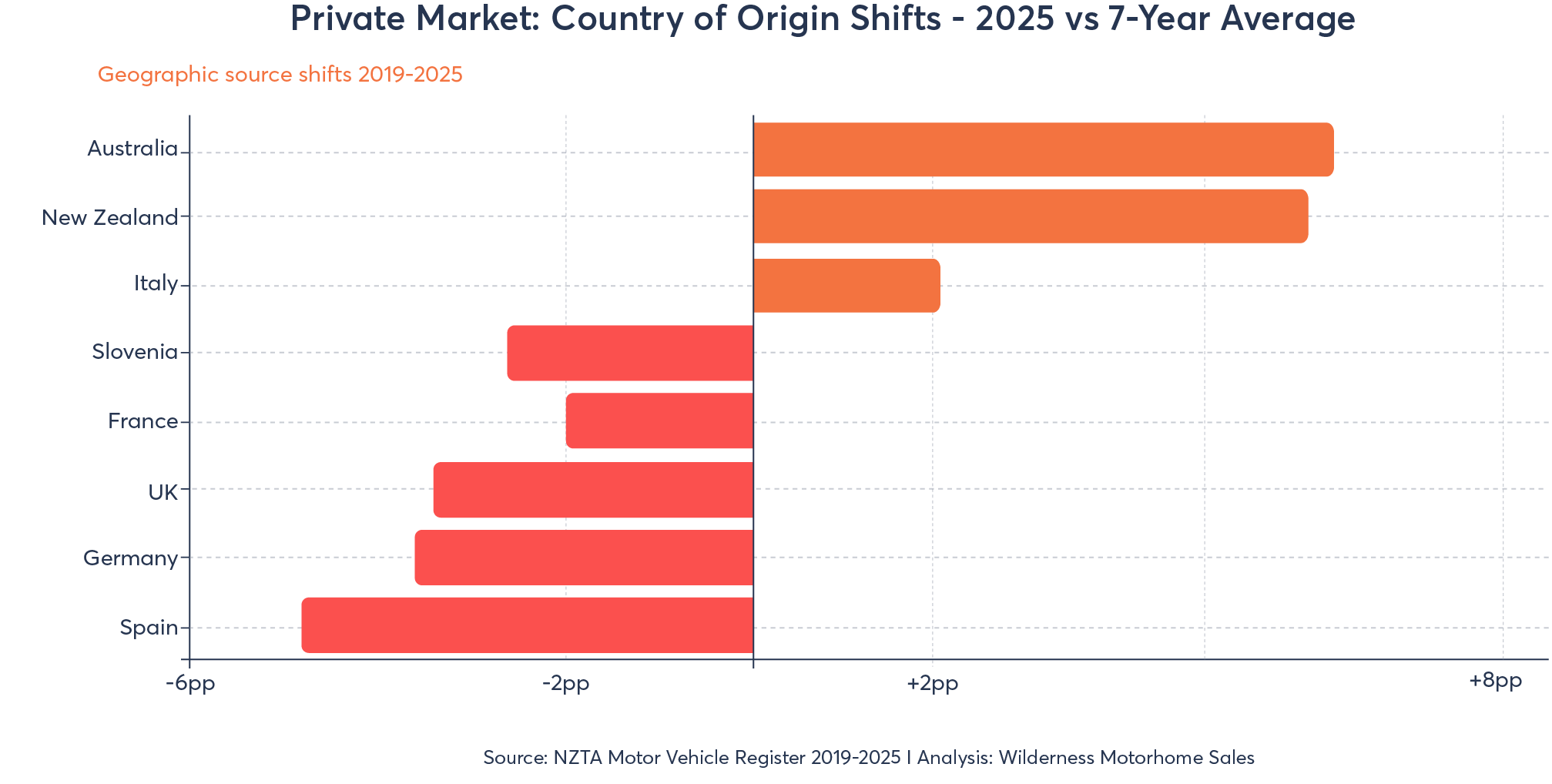
Australia’s gain is driven almost entirely by JAYCO’s surging popularity. New Zealand’s dramatic increase reflects improved attribution of NZ-built motorhomes in the data and the growing visibility of local manufacturers. Germany, Spain, and the United Kingdom all lost significant ground.
Platform Analysis: FIAT Ducato Maintains Private Market Lead
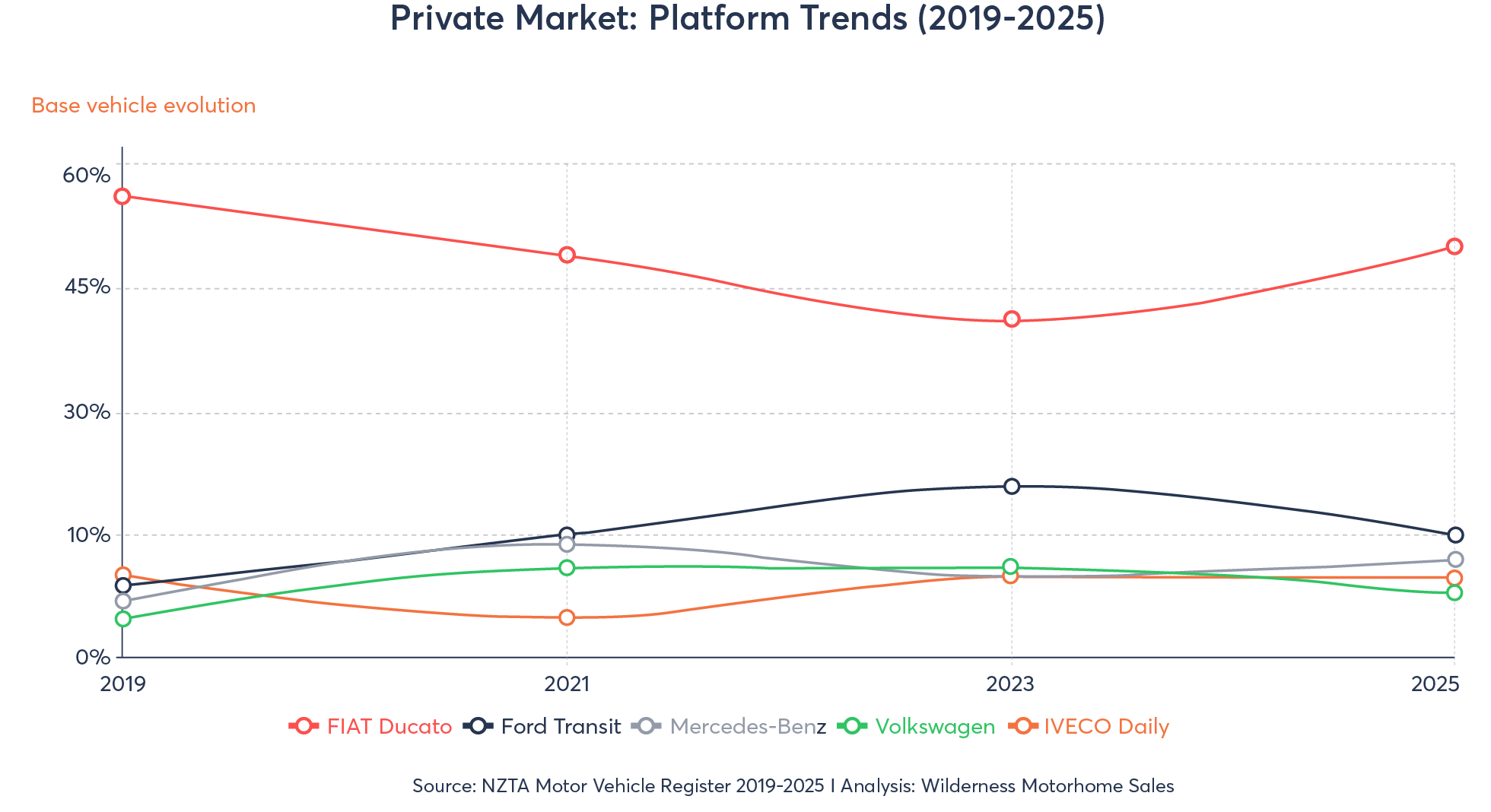
In the private market, FIAT Ducato reclaimed a 50.3% share in 2025—recovering from a low of 40.2% in 2024 and approaching its historical dominance.
|
Why FIAT Ducato Dominates FIAT Professional has deliberately tailored the Ducato platform for motorhome manufacturers, offering features such as a low frame, wide rear track, and compatibility with coach-built conversions. This focus on the motorhome sector—unique among commercial vehicle makers—has made the Ducato the chassis of choice for the majority of European motorhome builders. |
|
Platform |
2019 |
2020 |
2021 |
2022 |
2023 |
2024 |
2025 |
|
FIAT Ducato |
56.0% |
59.6% |
49.5% |
44.0% |
40.9% |
40.2% |
50.3% |
|
Ford Transit |
9.4% |
11.9% |
15.4% |
16.0% |
21.4% |
19.8% |
14.7% |
|
Mercedes-Benz |
7.1% |
7.5% |
14.5% |
14.7% |
9.7% |
12.1% |
11.8% |
|
IVECO Daily |
9.7% |
7.7% |
4.8% |
9.2% |
9.8% |
10.5% |
9.7% |
|
Volkswagen |
5.3% |
4.3% |
10.8% |
10.2% |
10.7% |
10.9% |
7.7% |
|
LDV |
2.8% |
0.9% |
0.9% |
0.9% |
1.9% |
2.5% |
2.7% |
Table 4: Private market platform shares by year
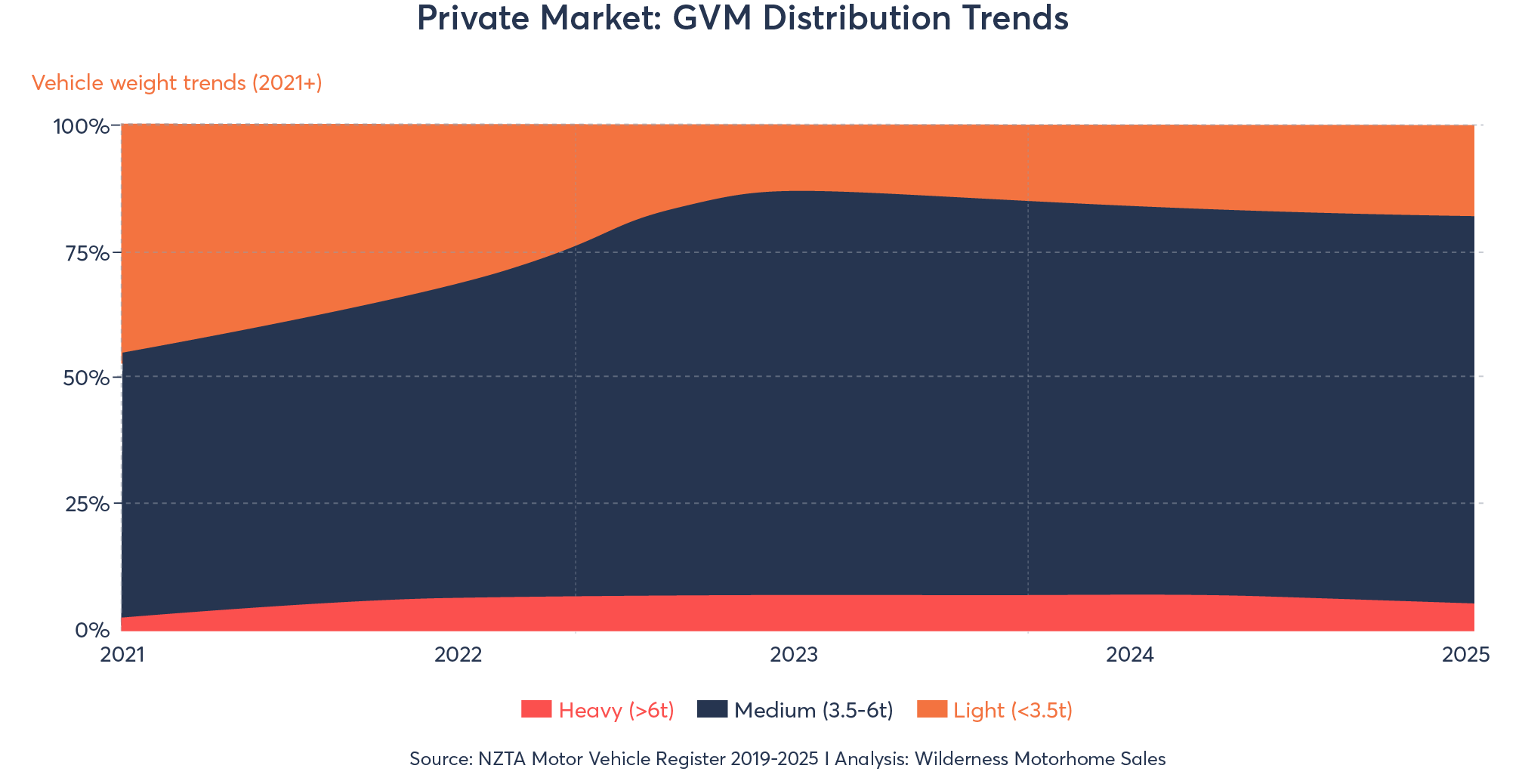
Between 2021 and 2025, new vehicle registrations saw a pronounced shift away from the sub-3,500kg category (which fell from 46% to 18% due to the Clean Car Standard and declining campervans) toward the 3.5–6.0 tonne category, which now dominates at 77% (up from 52%), reflecting the typical weight of coach-built European motorhomes.
Vehicle Weight Trends (GVM)
Gross Vehicle Mass data (available 2021–2025) reveals a pronounced shift away from lighter vehicles. The sub-3,500kg category has fallen from 46% of new registrations in 2021 to just 18% in 2025, largely reflecting the decline in VW California campervans and the Clean Car Standard’s impact on lighter commercial vehicles. The 3.5–6.0 tonne range now dominates at 77%, reflecting the typical weight of coach-built European motorhomes.
|
GVM Category |
2021 |
2022 |
2023 |
2024 |
2025 |
|
Up to 3,500kg |
46% |
33% |
13% |
16% |
18% |
|
3,501–6,000kg |
52% |
61% |
80% |
77% |
77% |
|
Over 6,000kg |
3% |
6% |
7% |
7% |
6% |
Table 6: Private market GVM distribution (2021–2025)
5. Industry Reference: Brands, Dealers, and Manufacturers
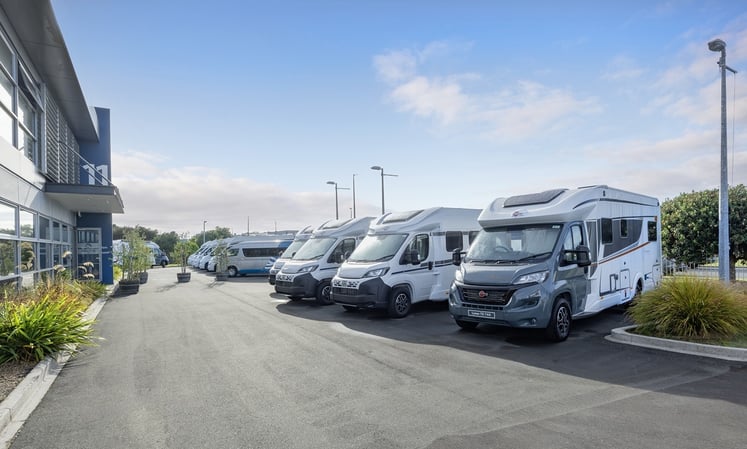
The New Zealand motorhome market is served by a network of specialist dealers importing from international manufacturers, alongside a small but significant local manufacturing sector. This section provides essential context for readers unfamiliar with the industry’s structure.
Major Brand Groups and Their NZ Distributors
Two European conglomerates dominate the NZ market, alongside significant independent brands:
|
Parent Company |
Brands in NZ |
Origin |
NZ Dealer(s) |
|
Trigano Group
|
Roller Team |
Italy |
RV Super Centre, Nationwide RV |
|
Benimar |
Spain |
TrailLite, RV Mega |
|
|
Auto-Trail |
UK |
Nationwide RV, Freedom RV |
|
|
CI, McLouis, Mobilvetta |
Italy |
Various |
|
|
Erwin Hymer Group
|
Bürstner, Carado, HYMER |
Germany |
Wilderness |
|
Dethleffs, Sunlight |
Germany |
Zion, UCC |
|
|
Laika, Etrusco |
Italy |
RV Super Centre, RV Mega |
|
|
Niesmann+Bischoff |
Germany |
Zion |
|
|
Carthago Group |
Carthago, Frankia, Morelo |
Germany |
Zion |
|
Swift Group |
Swift |
UK |
CMG Campers |
|
Bailey of Bristol |
Bailey |
UK |
RV Mega |
|
Adria Mobil |
Adria |
Slovenia |
RV Mega, Freedom RV |
|
Pilote Group |
Pilote, Le Voyageur, Joa |
France |
RV Mega, Deluxe Group |
|
Jayco Australia |
Jayco |
Australia |
Jayco Auckland, Jayco Canterbury |
|
THL (Action Mfg) |
KEA, Talvor |
New Zealand |
RV Super Centre |
Table A: Major motorhome brands, parent companies, and NZ distribution
Parent Company Performance
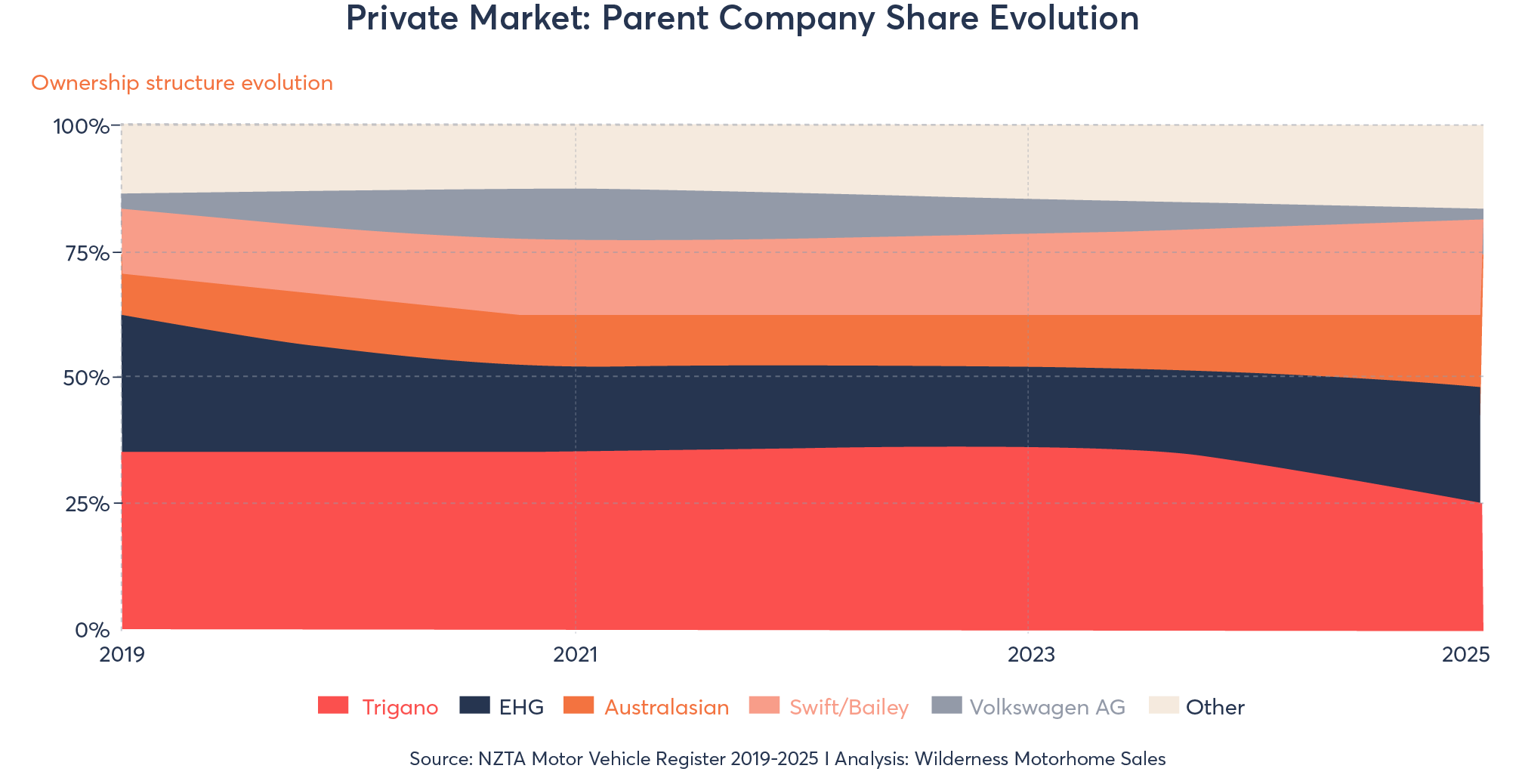
Analysis by the parent company in New Zealand reveals structural shifts in market power:
The Trigano Group
This French leisure vehicle conglomerate boasts a robust portfolio of motorhome brands, including Roller Team, Benimar, Auto-Trail, CI, McLouis, and Mobilvetta. To support its vast brand network, the company maintains a strong European manufacturing presence with production facilities spanning across Italy, Spain, and the United Kingdom.
In the New Zealand market, the group has recently experienced a downward trend. The company reached its peak in 2021, registering 456 units and capturing a dominant 28.6% market share. However, by 2025, sales volume had dropped significantly to 135 units, reducing their market share to 18.3%. This steady decline in the company's overall trajectory is being primarily driven by the falling market share of its Benimar brand.
The Erwin Hymer Group (EHG)
As Germany's largest motorhome conglomerate and a subsidiary of Thor Industries, EHG commands a diverse brand portfolio including Dethleffs, Bürstner, Carado, Hymer, Sunlight, Laika, Elddis, and Niesmann+Bischoff.
In the New Zealand market, EHG experienced a sharp decline from its 2020 peak of 266 units (21.3% market share) down to a low of just 70 units (9.3%) in 2024. However, the group staged an impressive recovery in 2025, rebounding to 131 units (17.7%). This strong resurgence has dramatically intensified local competition, narrowing the market share gap with their primary rival, the Trigano Group, to a mere 0.6 percentage points.
New Zealand Dealers by Region
The NZ motorhome retail market is served by approximately a dozen specialist dealers, concentrated in the upper North Island with growing South Island presence:
|
Dealer |
Location(s) |
Key Brands |
Notes |
|
Wilderness |
Auckland, Christchurch |
Bürstner, Carado, HYMER |
Exclusive importer of Bürstner, Carado, HYMER since 2012. Rental + retail. Family-owned and B Corp certified. |
|
RV Super Centre |
Auckland, Hamilton, Palmerston North, Queenstown, Christchurch |
KEA, Talvor, Laika, Roller Team |
Part of THL group. |
|
TrailLite |
Auckland, Christchurch |
TrailLite (NZ-built), Benimar, McLouis, Mobilvetta, Elddis, Xplore |
NZ’s oldest manufacturer (70+ yrs). |
|
Zion Motorhomes |
Pōkeno |
Carthago, Dethleffs, Sunlight |
Premium German specialists. Also McRent NZ. |
|
Nationwide RV |
Silverdale, New Plymouth, Ashburton, Pōkeno |
Roller Team, Auto-Trail |
Family-owned since 1989. |
|
Jayco Auckland |
Penrose, Auckland |
Jayco |
Dealer of the Year 9 consecutive years. |
|
Jayco Canterbury |
Christchurch |
Jayco |
South Island Jayco agent since 1966. |
|
RV Mega |
Mt Maunganui |
Bailey, Adria, Benimar, Pilote, Laika |
Largest privately-owned RV retailer. |
|
CMG Campers |
Christchurch |
Swift |
Only SI Swift Service Centre. 4,000sqm site. |
|
Deluxe Group |
Blenheim |
Pilote, Le Voyageur, Joa |
Ex-rental refurbishment specialists. |
|
Freedom RV |
Christchurch |
Adria, Auto-Trail |
South Island Adria agent. |
Table B: Major NZ motorhome dealers
Regional Market Distribution
Registration location data (available 2021–2025) reveals strong geographic concentration in the upper North Island, consistent with dealer locations and population distribution. Auckland accounts for nearly a quarter of all new private registrations, with Bay of Plenty and Canterbury the second and third largest markets.
|
Region |
Units (2021–2025) |
Share |
Trend |
|
Auckland |
1,150 |
22.9% |
Stable — NZ’s largest dealer concentration |
|
Bay of Plenty |
570 |
11.4% |
Declining share — from 12.8% to 8.9% |
|
Canterbury |
441 |
8.8% |
Recovering — strongest 2025 growth |
|
Waikato |
341 |
6.8% |
Declining — includes Pokeno (Zion) |
|
Wellington |
284 |
5.7% |
Declining sharply — 7.1% to 3.9% |
|
Taranaki |
226 |
4.5% |
Stable — driven by Nationwide RV (New Plymouth) |
|
Nelson-Marlborough |
196 |
3.9% |
Variable — includes Deluxe Group (Blenheim) |
|
Manawatu-Whanganui |
185 |
3.7% |
Stable |
|
Hawke’s Bay |
156 |
3.1% |
Declining |
|
Northland |
151 |
3.0% |
Variable |
|
Otago |
139 |
2.8% |
Stable |
|
Other regions |
107 |
2.1% |
— |
Table 7: Private market registrations by region (2021–2025)
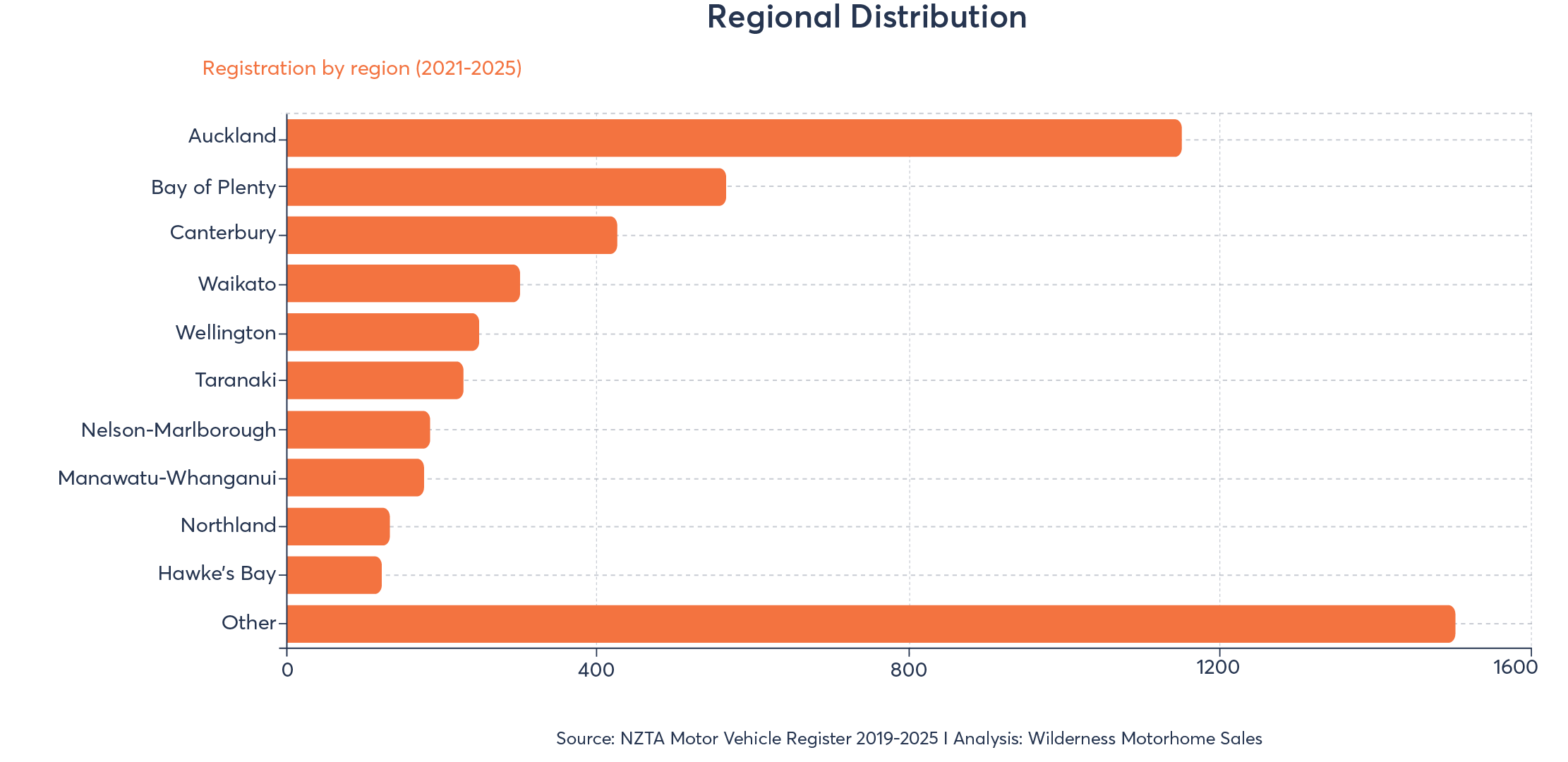
Notable observations: registration patterns correlate strongly with dealer locations. Taranaki’s share (4.5%) punches well above its population weight, driven by Nationwide RV’s New Plymouth base. Canterbury’s 2025 rebound (+38% year-on-year) suggests growing South Island demand.
New Zealand Motorhome Manufacturers
Despite the dominance of imports, a small group of NZ manufacturers continues to serve the market. Their products typically appear as ‘UNKNOWN’ in NZTA registration data because NZ builder brand names do not appear on vehicle compliance plates.
|
Manufacturer |
Location |
Platform(s) |
Notes |
|
Action Manufacturing |
Auckland |
Mercedes-Benz, IVECO, LDV |
Owned by THL. Builds KEA & Talvor for rental + retail. |
|
TrailLite |
Pukekohe |
IVECO Daily, VW Crafter, MB Sprinter |
NZ’s oldest (70+ yrs). Premium custom builds. |
|
ACM Motorhomes |
Auckland |
IVECO, LDV |
Hand-crafted custom motorhomes & caravans. |
|
Tranztec RV |
Thames |
FIAT Ducato, MB Sprinter |
Family business, 25+ years experience. |
|
ALM Group (Allisee) |
Hamilton |
Mercedes-Benz Sprinter |
Premium Allisee Supremacy with full slideout. |
|
Coastal Motorhomes |
Whakatane |
Various |
~8 units/year. Custom builds. |
|
Explorer Motorhomes |
Dairy Flat |
Ford Ranger 4WD |
Compact 4WD motorhomes for off-road touring. |
Table C: New Zealand motorhome manufacturers
Our proxy analysis of unbranded registrations on platforms used by NZ manufacturers estimates approximately 90–100 NZ-built motorhomes enter the private market annually (2023–2025 average), representing approximately 9% of the private market. This is likely an upper-bound estimate.
Understanding the Unidentified Segment
Approximately 22.7% of private market new registrations (1,669 units over seven years) appear as ‘UNKNOWN’ in NZTA records. This proportion has remained relatively stable at 17–29% across the study period. This segment likely comprises: NZ-built motorhomes from local manufacturers whose brand names do not appear on compliance plates; grey imports from Japan, UK, or Australia; custom and DIY conversions; and factory campervans registered under the base vehicle manufacturer only. The brand analysis in this report is based on registrations where brand attribution was possible.
6. The Campervan Market
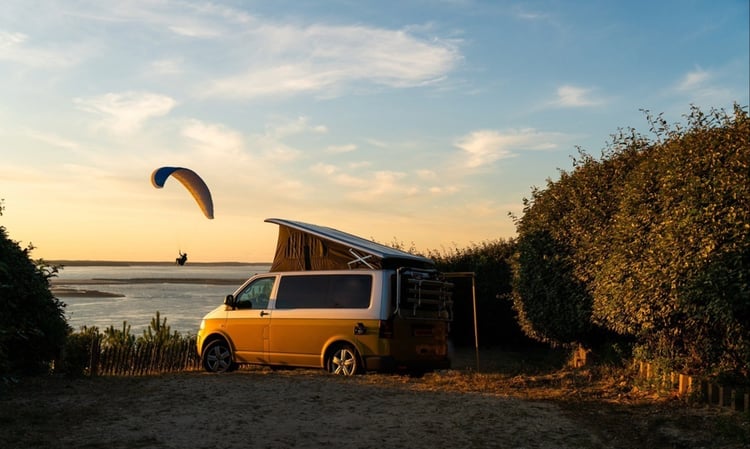
A significant and growing segment of the overall motor caravancollective term that encompasses both motorhomes (built on a truck chassis) and campervans (built on a van chassis). market is campervans—vehicles built on a van chassis rather than a truck chassis. Campervans are typically lighter, more manoeuvrable, and increasingly popular as ‘daily driver’ alternatives to traditional motorhomes. However, this growth remains largely confined to the tourism sector, showing little momentum in the private market.
Private Campervans: VW Decline, JAYCO Emergence
In the private market, campervans peaked at 204 units in 2021 before declining to 57 in 2025. This decline is driven by the collapse of Volkswagen California/Grand California imports, which fell from 135 units (2021) to just 13 (2025). JAYCO’s JRV campervan has partially filled the gap, growing from zero to 25 units in 2025, but has not replaced the VW volume.
|
Brand |
2019 |
2021 |
2023 |
2025 |
7-Year Total |
|
Volkswagen |
17 |
135 |
29 |
13 |
326 |
|
THL |
2 |
59 |
15 |
11 |
139 |
|
JAYCO |
0 |
0 |
14 |
25 |
67 |
|
Other |
13 |
10 |
7 |
8 |
28 |
|
Total Private CV |
32 |
204 |
55 |
57 |
560 |
Table 9: Private campervans by brand
7. Market Outlook: 2026 and Beyond
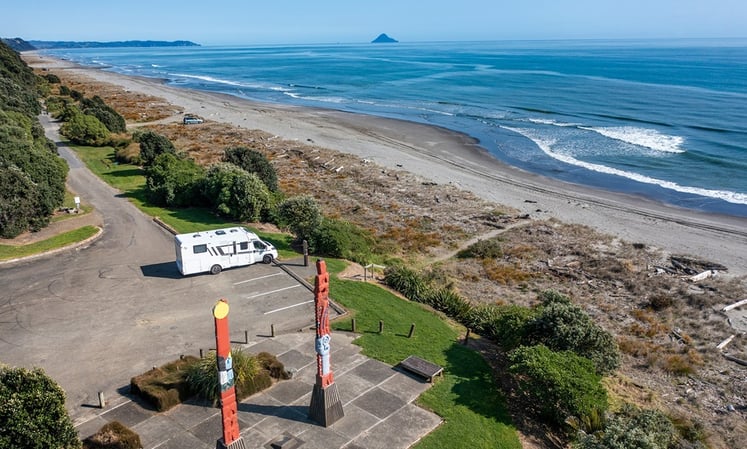
The 2025 data suggests the New Zealand motorhome market is entering a new phase characterised by normalisation after pandemic-era volatility.
Private Market Expectations
-
The COVID surplus has been fully absorbed, with a cumulative deficit of 166 units beyond payback. We expect new private registrations to stabilise around 700–800 units annually, potentially recovering toward 900–1,000 units over 2–3 years.
-
JAYCO’s dominance may strengthen further as Australian brands benefit from supply chain proximity and familiar design language.
-
Erwin Hymer Group brands are rebounding strongly—the group’s 2025 recovery to 17.7% (from 9.3% in 2024) suggests the portfolio’s NZ decline has bottomed out.
-
The campervan segment faces a crossroads: JAYCO JRV is growing but has not replaced the VW California volumes. New entrants in this space are likely.
8. Conclusion
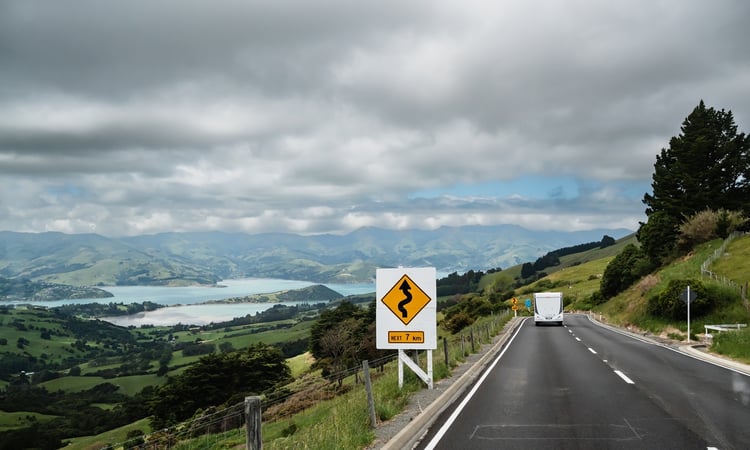
The New Zealand motorhome market in 2025 presents a picture of transition and normalisation. With seven years of data now available, we can distinguish temporary COVID-era disruptions from lasting structural changes.
Key structural shifts in the private market include:
-
JAYCO’s emergence as the private market leader, capturing 16.9% of known new registrations and reflecting a broader shift toward Australasian-sourced motorhomes (37.5% of known market, up from 23.9%).
-
The private market’s rate of decline slowing dramatically (−1.9% in 2025 vs −28.7% in 2023), suggesting the post-COVID contraction is nearing completion.
-
Erwin Hymer Group’s strong rebound (9.3% to 17.7%) nearly closing the gap with a declining Trigano Group (18.3%).
As the market settles into more predictable patterns, participants who have navigated the COVID-era volatility are well-positioned for sustainable growth. The fundamental appeal of motorhome travel – freedom, flexibility, and connection with New Zealand’s natural landscapes – remains strong, providing a solid foundation for the industry’s next chapter.
— End of Report —
Data source: NZTA Motor Vehicle Register 2019–2025
Analysis and report prepared by Wilderness Motorhome Sales
-
Trends, Brands and Buyer Insights (2019–2025)
Based on NZTA Motor Vehicle Register Data
Prepared by Mary Hamilton from Wilderness Motorhome Sales
February 2026
1. Executive Summary
This report presents a comprehensive analysis of the New Zealand motorhome market from 2019 to 2025, drawing on NZTA registration data to identify key trends in market composition, brand performance, platform use, and manufacturing origin. 2025 data shows significant market shifts and provides clarity on patterns of recovery post-COVID.
Key Findings:
-
Total registrations (private & tourism): 11,449 new motor caravanscollective term that encompasses both motorhomes (built on a truck chassis) and campervans (built on a van chassis). registered over seven years, averaging 1,635 units annually. The market peaked in 2024 at 1,904 units, then settled to 1,633 in 2025. Chinese-manufactured LDV platforms captured 12.6% of total 2025 registrations.
-
Private market approaching stabilisation: After four consecutive years of decline, the rate of contraction slowed markedly in 2025 (−1.9%) compared to prior years (−6.3% in 2024, −28.7% in 2023). At 739 units, the private market may be nearing its post-COVID floor.
-
Tourism refleeting complete: Rental fleet registrations normalised to 701 units in 2025 after aggressive 2023–2024 refleeting (1,970 combined), returning toward the pre-COVID baseline of 513.
-
JAYCO leads private sales: Australia’s leading brand captured 16.9% of the known private market in 2025 – up from 10.1% historically – becoming the #1 private brand for the first time.
-
Platform dominance: FIAT Ducato accounts for 50% of private registrations, maintaining its top position in the private market.
-
Market shifts toward higher GVM: New vehicle registrations saw a pronounced shift away from the sub-3,500kg category toward the 3.5–6.0 tonne category, which now dominates at 77% - reflecting the typical weight of coach-builtAn RV where a custom living area (the "coach") is built onto the back of a supplied "chassis-cab." European motorhomes.
-
Australasian shift: For the first time, Australasian-origin motorhomes (37.5% of known private market) have overtaken European sources, driven by JAYCO and NZ-built growth.
-
-
2. Introduction
The New Zealand motorhome market has undergone significant shifts between 2019 and 2025, shaped by the COVID-19 pandemic, global supply chain disruptions, changes in consumer behaviour, and broader economic conditions. Initially buoyed by strong domestic demand during border closures, the market saw a surge in registrations in 2020 and 2021. This was followed by a prolonged period of decline as supply constraints took hold and international travel resumed, which reshaped patterns of demand.
Sources and limitations of this report
This report draws on NZTA vehicle registration data to analyse the evolving dynamics of the market, including brand performance, sourcing regions, platform selection, and market segmentation. A key limitation of the data is that vehicle registrations are recorded based primarily on the vehicle platform – the first stage of manufacture. Motorhomes undergo a second stage of manufacturing where a base vehicle is converted into a motorhome by a specialist builder. This second stage is not consistently recorded in registration records.
As a result, important details about the motorhome conversion – such as the brand of the motorhome itself – are often missing. This is particularly problematic for locally built motorhomes, such as those produced by TrailLite, one of New Zealand’s largest private motorhome manufacturers, whose brand name does not appear on compliance plates. Approximately 23% of private market registrations across the seven-year period cannot be attributed to a specific brand.
A Note on Terminology
The NZTA classification ‘motor caravan’ is a collective term that encompasses both motorhomes (built on a truck chassis) and campervans (vans converted into mobile living spaces). It may also include a small number of equine transport vehicles and other vehicles that do not fit standard classifications. This report uses ‘motorhome’ as the general term, with ‘campervan’ used specifically where body type distinctions are relevant.
-
3. A Brief History of the NZ Motorhome Market
New Zealand’s motorhome industry is rooted in a national love of road trips and outdoor adventure. For generations, Kiwi families have embraced camping as a quintessential summer pastime, spending holidays in tents or caravans set against the country’s stunning natural landscapes. This enduring culture of road travel laid the foundation for New Zealand’s domestic RV industry.
From Caravans to Motorhomes
As camping grew in popularity, caravans became the next evolution. By the 1950s, small-scale caravan manufacturing was booming in towns across New Zealand. Local producers like CI Munro, Jackson Caravans, and Liteweight built robust, practical models. The industry peaked in the 1970s before collapsing in 1979 due to a new luxury tax, from which it never fully recovered.
As caravans waned, motorhomes took off. CI Munro pivoted to motorhome production in the 1970s and was later acquired by Tourism Holdings Ltd (THL) in 1995. Rebranded as Action Manufacturing, it became the country’s largest producer, building for rental brands like maui and Britz. TrailLite, based in Pukekohe, also transitioned from caravan to motorhome production, evolving into New Zealand’s oldest and most established private motorhome manufacturer.
The earliest NZ-built motorhomes were practical and built for rugged conditions—based on underpowered Japanese trucks, carrying over caravan-style layouts with overcab berths and rear club lounges. These features remain common in locally built models today, though European design elements are increasingly influential.
The Rise of Imports and Decline of Local Manufacturing
The most significant transformation in the New Zealand motorhome market has been the shift from locally manufactured vehicles to imports. This transition unfolded over two decades:
-
Pre-2000s: Most motorhomes were built locally by companies like TrailLite, Kea, and various caravan converters. Imports were limited to privately sourced vehicles and converted Japanese buses.
-
Early 2000s: New Zealand’s strong dollar and reduced import barriers made European models attractive. Compact, efficient layouts and modern fit-outs drew consumer interest.
-
2004–2012: European brands like Benimar, Roller Team, and Bürstner grew rapidly. UK-built Swift and Auto-Trail models became popular with retirees. NZ manufacturers struggled to compete on price and volume.
-
2015–2020: Imports dominated the majority of new registrations. Many smaller local manufacturers closed, unable to compete with international scale and pricing.
-
2020–2022: COVID-era supply disruptions caused a temporary return to local builds as THL expanded NZ-based production. Demand for used motorhomes surged.
-
2023–present: Imports returned as supply chains recovered. The market now reflects a diverse mix of European, Australian, UK, and NZ-built motorhomes.
Today, Action Manufacturing (THL) and TrailLite remain the standout local producers in a landscape dominated by international brands. Boutique NZ manufacturers, including ACM Motorhomes, Tranztec RV, ALM Group (Allisee), Coastal Motorhomes, and Explorer Motorhomes, continue to serve niche segments with bespoke and premium builds.
-
-
4. Private Market Analysis
Market Trajectory: Approaching Stabilisation
The private market recorded 739 new registrations in 2025, representing a 1.9% decline from 2024’s 753 units. While this marks the fifth consecutive year of decline since 2021’s peak of 1,597 units, the rate of contraction has slowed dramatically – from -29.4% (2022), to -28.7% (2023), to -6.3% (2024), to just -1.9% in 2025. This deceleration suggests the market may be approaching its post-COVID floor.
The 2025 figure remains 31.1% below the 2019 baseline of 1,072 units. The seven-year average of 1,048 private registrations annually indicates the current level represents a significant contraction from historical patterns.
COVID Impact Analysis: Surplus Fully Absorbed
Using 2019 as the baseline year (1,072 new registrations), the COVID surplus period of 2020–2022 generated 754 units above baseline. This showed a pull-forward demand as locked-down consumers invested in domestic travel. The subsequent deficit period of 2023–2025 saw 920 units below baseline as the market worked through the surplus and faced economic headwinds. The net position at the end of 2025 stands at 166 units below the cumulative baseline, indicating the payback period is complete and then some.
Year
Private
Variance vs Baseline
Cumulative
Period
2019
1,072
0
0
Baseline
2020
1,246
+174
+174
Surplus
2021
1,597
+525
+699
Surplus
2022
1,127
+55
+754
Surplus
2023
804
−268
+486
Deficit
2024
753
−319
+167
Deficit
2025
739
−333
−166
Deficit
Table 2: Private market COVID surplus/deficit analysis (baseline = 2019)
This analysis suggests 2026 should see continued stabilisation, with annual registrations potentially recovering toward 800–1,000 units over the medium term.
Brand Performance: 2025 Reshapes the Leaderboard
The 2025 data reveals significant shifts in brand rankings, with JAYCO emerging as the dominant private brand for the first time. The following analysis is based on the 77% of private registrations where the motorhome brand was identifiable (569 of 739 units in 2025).
Rank
Brand
2025 Units
2025 Share
7-Year Share
Change
1
JAYCO
96
16.9%
10.1%
+6.8pp
2
Roller Team
74
13.0%
10.1%
+2.9pp
3
THL
46*
8.1%
7.3%
+0.8pp
4
Swift
30
5.3%
4.0%
+1.3pp
5
Benimar
27
4.7%
9.6%
−4.9pp
6
Dethleffs
26
4.6%
7.7%
−3.1pp
7
Bürstner
22
3.9%
4.0%
−0.1pp
8
Sunlight
20
3.5%
1.7%
+1.8pp
9
Laika
20
3.5%
0.8%
+2.7pp
10
Carado
20
3.5%
2.9%
+0.6pp
Table 3: Top 10 private market brands in 2025 (known brands only)
*THL reported 109 retail sales for FY25. The discrepancy with our 46-unit NZTA figure is likely due to THL's July year-end and units sitting in the unidentified segment.
Key observations:
-
JAYCO’s 6.8 percentage point gain is the largest brand shift in the dataset, driven by strong dealer support and Australian supply chain proximity.
-
7 of 10 top brands are gaining share, indicating healthy consolidation around quality performers.
-
New entrants Sunlight (+1.8pp) and Laika (+2.7pp) have broken into the top 10, displacing traditional favourites.
-
Benimar (−4.9pp) and Dethleffs (−3.1pp) experienced the sharpest declines among established brands.
Country of Origin: The Australasian Shift
The geographic source of private motorhomes shifted dramatically in 2025. Among identifiable brands, Australasian-origin vehicles (Australia + New Zealand) now represent 37.5% of the known private market—up from 23.9% historically. This is the most striking geographic shift in the dataset, with Australasian sources overtaking European imports for the first time.
Country
2025 Share
7-Year Share
Change
Germany
21.9%
26.0%
−4.2pp
New Zealand
19.4%
11.4%
+8.0pp
Italy
19.9%
18.5%
+1.4pp
Australia
18.1%
12.5%
+5.7pp
United Kingdom
12.3%
16.0%
−3.7pp
Spain
4.8%
9.8%
−5.0pp
France
2.7%
4.7%
−2.0pp
Slovenia
0.9%
1.1%
−0.2pp
Table 5: Private market country of origin — 2025 vs 7-year average (known brands only)
Australia’s gain is driven almost entirely by JAYCO’s surging popularity. New Zealand’s dramatic increase reflects improved attribution of NZ-built motorhomes in the data and the growing visibility of local manufacturers. Germany, Spain, and the United Kingdom all lost significant ground.
Platform Analysis: FIAT Ducato Maintains Private Market Lead
In the private market, FIAT Ducato reclaimed a 50.3% share in 2025—recovering from a low of 40.2% in 2024 and approaching its historical dominance.
Why FIAT Ducato Dominates
FIAT Professional has deliberately tailored the Ducato platform for motorhome manufacturers, offering features such as a low frame, wide rear track, and compatibility with coach-built conversions. This focus on the motorhome sector—unique among commercial vehicle makers—has made the Ducato the chassis of choice for the majority of European motorhome builders.
Platform
2019
2020
2021
2022
2023
2024
2025
FIAT Ducato
56.0%
59.6%
49.5%
44.0%
40.9%
40.2%
50.3%
Ford Transit
9.4%
11.9%
15.4%
16.0%
21.4%
19.8%
14.7%
Mercedes-Benz
7.1%
7.5%
14.5%
14.7%
9.7%
12.1%
11.8%
IVECO Daily
9.7%
7.7%
4.8%
9.2%
9.8%
10.5%
9.7%
Volkswagen
5.3%
4.3%
10.8%
10.2%
10.7%
10.9%
7.7%
LDV
2.8%
0.9%
0.9%
0.9%
1.9%
2.5%
2.7%
Table 4: Private market platform shares by year
Between 2021 and 2025, new vehicle registrations saw a pronounced shift away from the sub-3,500kg category (which fell from 46% to 18% due to the Clean Car Standard and declining campervans) toward the 3.5–6.0 tonne category, which now dominates at 77% (up from 52%), reflecting the typical weight of coach-built European motorhomes.
Vehicle Weight Trends (GVM)
Gross Vehicle Mass data (available 2021–2025) reveals a pronounced shift away from lighter vehicles. The sub-3,500kg category has fallen from 46% of new registrations in 2021 to just 18% in 2025, largely reflecting the decline in VW California campervans and the Clean Car Standard’s impact on lighter commercial vehicles. The 3.5–6.0 tonne range now dominates at 77%, reflecting the typical weight of coach-built European motorhomes.
GVM Category
2021
2022
2023
2024
2025
Up to 3,500kg
46%
33%
13%
16%
18%
3,501–6,000kg
52%
61%
80%
77%
77%
Over 6,000kg
3%
6%
7%
7%
6%
Table 6: Private market GVM distribution (2021–2025)
-
-
5. Industry Reference: Brands, Dealers, and Manufacturers
The New Zealand motorhome market is served by a network of specialist dealers importing from international manufacturers, alongside a small but significant local manufacturing sector. This section provides essential context for readers unfamiliar with the industry’s structure.
Major Brand Groups and Their NZ Distributors
Two European conglomerates dominate the NZ market, alongside significant independent brands:
Parent Company
Brands in NZ
Origin
NZ Dealer(s)
Trigano Group
Roller Team
Italy
RV Super Centre, Nationwide RV
Benimar
Spain
TrailLite, RV Mega
Auto-Trail
UK
Nationwide RV, Freedom RV
CI, McLouis, Mobilvetta
Italy
Various
Erwin Hymer Group
Bürstner, Carado, HYMER
Germany
Wilderness
Dethleffs, Sunlight
Germany
Zion, UCC
Laika, Etrusco
Italy
RV Super Centre, RV Mega
Niesmann+Bischoff
Germany
Zion
Carthago Group
Carthago, Frankia, Morelo
Germany
Zion
Swift Group
Swift
UK
CMG Campers
Bailey of Bristol
Bailey
UK
RV Mega
Adria Mobil
Adria
Slovenia
RV Mega, Freedom RV
Pilote Group
Pilote, Le Voyageur, Joa
France
RV Mega, Deluxe Group
Jayco Australia
Jayco
Australia
Jayco Auckland, Jayco Canterbury
THL (Action Mfg)
KEA, Talvor
New Zealand
RV Super Centre
Table A: Major motorhome brands, parent companies, and NZ distribution
Parent Company Performance
Analysis by the parent company in New Zealand reveals structural shifts in market power:
The Trigano Group
This French leisure vehicle conglomerate boasts a robust portfolio of motorhome brands, including Roller Team, Benimar, Auto-Trail, CI, McLouis, and Mobilvetta. To support its vast brand network, the company maintains a strong European manufacturing presence with production facilities spanning across Italy, Spain, and the United Kingdom.
In the New Zealand market, the group has recently experienced a downward trend. The company reached its peak in 2021, registering 456 units and capturing a dominant 28.6% market share. However, by 2025, sales volume had dropped significantly to 135 units, reducing their market share to 18.3%. This steady decline in the company's overall trajectory is being primarily driven by the falling market share of its Benimar brand.
The Erwin Hymer Group (EHG)
As Germany's largest motorhome conglomerate and a subsidiary of Thor Industries, EHG commands a diverse brand portfolio including Dethleffs, Bürstner, Carado, Hymer, Sunlight, Laika, Elddis, and Niesmann+Bischoff.
In the New Zealand market, EHG experienced a sharp decline from its 2020 peak of 266 units (21.3% market share) down to a low of just 70 units (9.3%) in 2024. However, the group staged an impressive recovery in 2025, rebounding to 131 units (17.7%). This strong resurgence has dramatically intensified local competition, narrowing the market share gap with their primary rival, the Trigano Group, to a mere 0.6 percentage points.
New Zealand Dealers by Region
The NZ motorhome retail market is served by approximately a dozen specialist dealers, concentrated in the upper North Island with growing South Island presence:
Dealer
Location(s)
Key Brands
Notes
Wilderness
Auckland, Christchurch
Bürstner, Carado, HYMER
Exclusive importer of Bürstner, Carado, HYMER
since 2012. Rental + retail. Family-owned and B Corp certified.
RV Super Centre
Auckland, Hamilton, Palmerston North, Queenstown, Christchurch
KEA, Talvor, Laika, Roller Team
Part of THL group.
TrailLite
Auckland, Christchurch
TrailLite (NZ-built), Benimar, McLouis, Mobilvetta, Elddis, Xplore
NZ’s oldest manufacturer (70+ yrs).
Zion Motorhomes
Pōkeno
Carthago, Dethleffs, Sunlight
Premium German specialists. Also McRent NZ.
Nationwide RV
Silverdale, New Plymouth, Ashburton, Pōkeno
Roller Team, Auto-Trail
Family-owned since 1989.
Jayco Auckland
Penrose, Auckland
Jayco
Dealer of the Year 9 consecutive years.
Jayco Canterbury
Christchurch
Jayco
South Island Jayco agent since 1966.
RV Mega
Mt Maunganui
Bailey, Adria, Benimar, Pilote, Laika
Largest privately-owned RV retailer.
CMG Campers
Christchurch
Swift
Only SI Swift Service Centre. 4,000sqm site.
Deluxe Group
Blenheim
Pilote, Le Voyageur, Joa
Ex-rental refurbishment specialists.
Freedom RV
Christchurch
Adria, Auto-Trail
South Island Adria agent.
Table B: Major NZ motorhome dealers
Regional Market Distribution
Registration location data (available 2021–2025) reveals strong geographic concentration in the upper North Island, consistent with dealer locations and population distribution. Auckland accounts for nearly a quarter of all new private registrations, with Bay of Plenty and Canterbury the second and third largest markets.
Region
Units (2021–2025)
Share
Trend
Auckland
1,150
22.9%
Stable — NZ’s largest dealer concentration
Bay of Plenty
570
11.4%
Declining share — from 12.8% to 8.9%
Canterbury
441
8.8%
Recovering — strongest 2025 growth
Waikato
341
6.8%
Declining — includes Pokeno (Zion)
Wellington
284
5.7%
Declining sharply — 7.1% to 3.9%
Taranaki
226
4.5%
Stable — driven by Nationwide RV (New Plymouth)
Nelson-Marlborough
196
3.9%
Variable — includes Deluxe Group (Blenheim)
Manawatu-Whanganui
185
3.7%
Stable
Hawke’s Bay
156
3.1%
Declining
Northland
151
3.0%
Variable
Otago
139
2.8%
Stable
Other regions
107
2.1%
—
Table 7: Private market registrations by region (2021–2025)
Notable observations: registration patterns correlate strongly with dealer locations. Taranaki’s share (4.5%) punches well above its population weight, driven by Nationwide RV’s New Plymouth base. Canterbury’s 2025 rebound (+38% year-on-year) suggests growing South Island demand.
New Zealand Motorhome Manufacturers
Despite the dominance of imports, a small group of NZ manufacturers continues to serve the market. Their products typically appear as ‘UNKNOWN’ in NZTA registration data because NZ builder brand names do not appear on vehicle compliance plates.
Manufacturer
Location
Platform(s)
Notes
Action Manufacturing
Auckland
Mercedes-Benz, IVECO, LDV
Owned by THL. Builds KEA & Talvor for rental + retail.
TrailLite
Pukekohe
IVECO Daily, VW Crafter, MB Sprinter
NZ’s oldest (70+ yrs). Premium custom builds.
ACM Motorhomes
Auckland
IVECO, LDV
Hand-crafted custom motorhomes & caravans.
Tranztec RV
Thames
FIAT Ducato, MB Sprinter
Family business, 25+ years experience.
ALM Group (Allisee)
Hamilton
Mercedes-Benz Sprinter
Premium Allisee Supremacy with full slideout.
Coastal Motorhomes
Whakatane
Various
~8 units/year. Custom builds.
Explorer Motorhomes
Dairy Flat
Ford Ranger 4WD
Compact 4WD motorhomes for off-road touring.
Table C: New Zealand motorhome manufacturers
Our proxy analysis of unbranded registrations on platforms used by NZ manufacturers estimates approximately 90–100 NZ-built motorhomes enter the private market annually (2023–2025 average), representing approximately 9% of the private market. This is likely an upper-bound estimate.
Understanding the Unidentified Segment
Approximately 22.7% of private market new registrations (1,669 units over seven years) appear as ‘UNKNOWN’ in NZTA records. This proportion has remained relatively stable at 17–29% across the study period. This segment likely comprises: NZ-built motorhomes from local manufacturers whose brand names do not appear on compliance plates; grey imports from Japan, UK, or Australia; custom and DIY conversions; and factory campervans registered under the base vehicle manufacturer only. The brand analysis in this report is based on registrations where brand attribution was possible.
-
6. The Campervan Market
A significant and growing segment of the overall motor caravancollective term that encompasses both motorhomes (built on a truck chassis) and campervans (built on a van chassis). market is campervans—vehicles built on a van chassis rather than a truck chassis. Campervans are typically lighter, more manoeuvrable, and increasingly popular as ‘daily driver’ alternatives to traditional motorhomes. However, this growth remains largely confined to the tourism sector, showing little momentum in the private market.
Private Campervans: VW Decline, JAYCO Emergence
In the private market, campervans peaked at 204 units in 2021 before declining to 57 in 2025. This decline is driven by the collapse of Volkswagen California/Grand California imports, which fell from 135 units (2021) to just 13 (2025). JAYCO’s JRV campervan has partially filled the gap, growing from zero to 25 units in 2025, but has not replaced the VW volume.
Brand
2019
2021
2023
2025
7-Year Total
Volkswagen
17
135
29
13
326
THL
2
59
15
11
139
JAYCO
0
0
14
25
67
Other
13
10
7
8
28
Total Private CV
32
204
55
57
560
Table 9: Private campervans by brand
-
7. Market Outlook: 2026 and Beyond
The 2025 data suggests the New Zealand motorhome market is entering a new phase characterised by normalisation after pandemic-era volatility.
Private Market Expectations
-
The COVID surplus has been fully absorbed, with a cumulative deficit of 166 units beyond payback. We expect new private registrations to stabilise around 700–800 units annually, potentially recovering toward 900–1,000 units over 2–3 years.
-
JAYCO’s dominance may strengthen further as Australian brands benefit from supply chain proximity and familiar design language.
-
Erwin Hymer Group brands are rebounding strongly—the group’s 2025 recovery to 17.7% (from 9.3% in 2024) suggests the portfolio’s NZ decline has bottomed out.
-
The campervan segment faces a crossroads: JAYCO JRV is growing but has not replaced the VW California volumes. New entrants in this space are likely.
-
-
8. Conclusion
The New Zealand motorhome market in 2025 presents a picture of transition and normalisation. With seven years of data now available, we can distinguish temporary COVID-era disruptions from lasting structural changes.
Key structural shifts in the private market include:
-
JAYCO’s emergence as the private market leader, capturing 16.9% of known new registrations and reflecting a broader shift toward Australasian-sourced motorhomes (37.5% of known market, up from 23.9%).
-
The private market’s rate of decline slowing dramatically (−1.9% in 2025 vs −28.7% in 2023), suggesting the post-COVID contraction is nearing completion.
-
Erwin Hymer Group’s strong rebound (9.3% to 17.7%) nearly closing the gap with a declining Trigano Group (18.3%).
As the market settles into more predictable patterns, participants who have navigated the COVID-era volatility are well-positioned for sustainable growth. The fundamental appeal of motorhome travel – freedom, flexibility, and connection with New Zealand’s natural landscapes – remains strong, providing a solid foundation for the industry’s next chapter.
— End of Report —
Data source: NZTA Motor Vehicle Register 2019–2025
Analysis and report prepared by Wilderness Motorhome Sales
-

