
Most of us know our rights when making a major purchase like a car or a house. A motorhome sits in an odd space where it’s both at once.
That habitation area brings its own list of things that can go wrong, on top of anything you'd worry about with a regular vehicle. The cabin can develop a leak, appliances can play up, and the solar or gas systems can fail. And that's before we even get to the usual mechanical faults that come with any motor vehicle.
So what legal protections do you actually have if the motorhome of your dreams turns out faulty, or doesn't do what the dealer told you it would?
New Zealand law gives you some very strong customer protections. Let's take a closer look at what they are and how they apply when you're buying a motorhome.
Does the Consumer Guarantees Act (CGA) apply when buying a motorhome in New Zealand?

Yes – all commercial motor vehicle transactions are covered.
The CGA applies to any motorhome bought from a registered motor vehicle dealer for personal use, whether it's brand new or secondhand. Anyone buying and selling motor vehicles as a commercial business must be registered, and the Act applies to all their sales to private buyers.
Does the CGA apply to private sellers?
Private sales are all "buyer beware," whether that's responding to an ad on Trade Me or spotting a motorhome for sale on the side of the road. The CGA doesn't protect you when you're buying from a private seller.
Always check a seller's other listings when you're working your way through the private ads on Trade Me. If they've got other motorhomes listed alongside the one that caught your eye, they could be acting as an unregistered motor vehicle trader, which isn't legal.
If you suspect this, check the seller against the Motor Vehicle Traders Register, and if they're not listed, report them through the register's complaint form (screenshots of their other listings are good evidence).
Want to know more about the pros and cons of buying from a private seller? Check out our guide.
How to make sure you're covered
All registered dealers must appear on the Motor Vehicle Traders Register, and you'll only get CGA protection if you buy from one.
Key facts:
-
Anyone who imports more than three vehicles in 12 months, or sells more than six in a year, is required to be on that register
-
You can check whether a particular dealer is listed on the Motor Vehicle Traders Register
-
Registered dealers can't opt out of their responsibilities under the Act by getting buyers to sign an "as is, where is" clause
-
If a dealer tries to add one, they're not just breaching the Consumer Guarantees Act – they're falling foul of the Fair Trading Act too
In 2018, an Auckland car dealership was taken to court for trying to sell trade-in cars on Trade Me as "as is where is" with "no guarantee or warranty" attached. The court didn't buy it – dealers can't just write the CGA out of a sale, no matter what the listing says – and the dealership was hit with fines of over $75,000.
What is a Consumer Information Notice (CIN)?
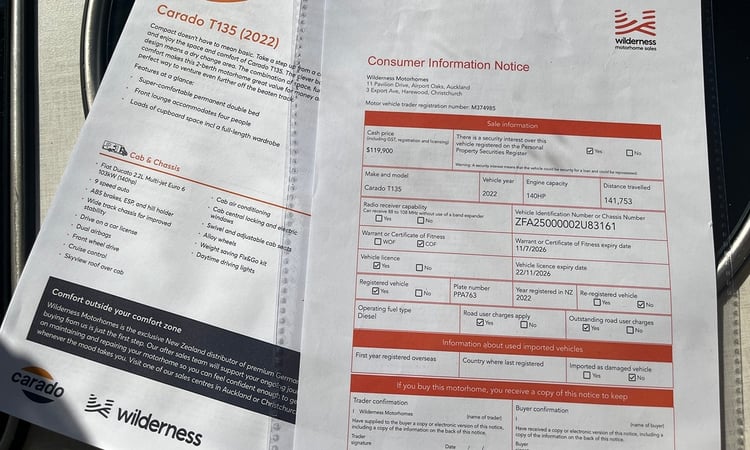
Registered dealers must attach a CIN to every used motorhome they display for sale, listing:
-
Vehicle specifications
-
Age
-
Distance travelled
New vehicles and private sales don't require one.
If you're buying a used motorhome from a registered dealer, make sure you get a signed copy of the CIN – it'll come in handy if any of the described features turn out faulty, or if you spot wear and tear that doesn't match up with the stated mileage.
What rights do I have under the CGA when buying a motorhome?

A registered motorhome dealer has to sell vehicles that are of "acceptable quality" and "fit for purpose." If your motorhome doesn't meet either of those two standards, you've got a legal right to have the dealer sort it out.
Let's take a closer look at both, since they're the foundation of everything else in the Act.
Is the motorhome of acceptable quality?
A motorhome needs to do everything it's meant to do. That means:
-
Every system is in good working order
-
Free of defects, habitable, and safe to drive
-
Lasting a reasonable amount of time
If it falls short, the Act says: "When these guarantees aren't met, the owner can expect the business (the dealer) to remedy the situation promptly."
There's no time limit built into the CGA. What counts as "acceptable" depends on:
-
The vehicle's age and condition
-
What you paid for it
-
Any claims the dealer made along the way
The pricier the motorhome, the higher the bar – a $200,000 new motorhome is held to a tougher standard than a $30,000 secondhand one.
Your CGA rights can also outlast the manufacturer's or dealer's warranty. If a fault turns up within what you'd reasonably expect to be the motorhome's serviceable life – and you've used it reasonably and kept up with servicing – you can still expect the dealer to remedy it promptly.
Is the motorhome fit for purpose?
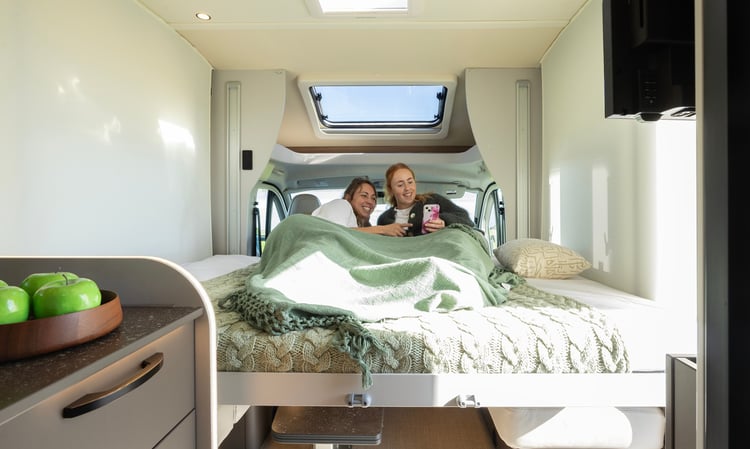
The motorhome needs to be able to do whatever you bought it for. If you've got specific plans in mind, make sure you talk them through with the dealer before you buy. These could include:
-
Freedom camping
-
Long-term living
-
Towing
Once the dealer knows what you need it for, they're on the hook for fixing any faults that crop up from that use.
Every so often, a buyer's plans stretch well beyond what counts as reasonable use. Take the owner of two pubs in the Northern Territory in Australia, who kept blowing the transmissions on his new Holden station wagons and getting them replaced under warranty, year after year. Turned out he was picking up his beer delivery in Darwin, splitting it in two, and overloading the wagon to restock his other pub hundreds of kilometres away. Thanks to the Territory's lack of an open-road speed limit, he could make the run in a little over an hour at an average of 200 km/h. Those Holdens were never built for high-speed beer runs, and if he'd mentioned his plans to the dealer upfront, they probably wouldn't have sold him the car in the first place.
What is the difference between a dealer warranty and my CGA rights?
A dealer warranty is a contract with a time limit; your CGA rights are a legal guarantee that never expires and can't be overridden.
How the two compare
A warranty is an agreement between you and the dealership and/or manufacturer, covering you for a set time period or number of kilometres, whichever comes first. The CGA works differently:
-
It applies to every motorhome sold by a registered dealer, regardless of what the warranty says
-
If you're invoking your CGA rights to get a fault fixed, it's the dealer who sold you the motorhome that has to deal with it, not the manufacturer. They can't tell you "that's their problem, not ours."
An extended warranty can sometimes be worth having – cover for accident damage repairs or mechanical breakdown, for example. But check the fine print carefully to see whether it's actually offering you anything beyond what the CGA already covers. By law, an extended warranty has to clearly state what benefits it offers over your CGA rights, so it's worth reading closely – the extension on offer might not be worth paying extra for.
What happens if my new or used motorhome develops a major fault?
A fault is major if a reasonable buyer wouldn't have purchased the motorhome knowing about it, it's unsafe, or it's significantly different from how it was described or advertised.
-
For minor faults, the dealer chooses whether to repair, replace, or refund.
-
For major faults, you choose: reject the vehicle for a full refund or replacement, or keep it and claim compensation for the drop in value.
-
You can also reject the vehicle if a fault can't be fixed, or the dealer can't fix it within a reasonable time.
Any refund has to be cash or a reversal of the original payment – credit isn't acceptable under the Act. You can also claim for related costs, like accommodation if you're stranded or hiring another vehicle while repairs are made.
Confused about warranties? Check out our complete guide to motorhome warranties.
What if it ends up in a dispute?
Disputes can go to the Disputes Tribunal, which can now rule on claims of up to $60,000 as of January 2026. For larger sums – a full refund or replacement of a higher-value motorhome – the dispute goes to the Motor Vehicle Disputes Tribunal instead. Both are low-cost and don't require legal representation.
Timing matters too:
-
There's no fixed deadline in the Act for exercising your right to reject once you've found a fault, but it must be done within a “reasonable time” of a fault being found.
-
If you let time pass before contacting the dealer, they could argue that continuing to drive the motorhome made the fault worse, which weakens your case if a dispute arises.
A recent ruling by the Motor Vehicle Disputes Tribunal highlights how time frames can affect judgments:
“Where serious failure happens months later, the Tribunal may not accept a rejection claim unless the buyer can show, on the balance of probabilities, that the defect existed at the time of sale. Continued driving after warning signs, without proper inspection or servicing, can weaken a buyer’s case.”
Your Motorhome Purchase Contract Checklist: What to check before signing

A few minutes spent checking these before you sign could save you a world of hassle down the track:
-
Confirm the dealer is listed on the Motor Vehicle Traders Register.
-
If you’re buying a used vehicle, go straight to the CIN so you know exactly what you're considering.
-
Get written confirmation of what warranty covers the motorhome platform, and what separately covers the habitation unit. There's likely to be a third warranty covering water ingress, too.
-
Walk away if the dealer tries to add an "as is, where is" clause or any CGA exclusion to the sales agreement – that's not something they're allowed to do.
-
Make sure the dealer knows exactly what you plan to use the motorhome for, and get them to confirm in writing (if possible) that it'll handle those uses without issue.
-
If you want an extra layer of certainty, especially if you’re buying privately, get the motorhome independently assessed. It'll add a bit to the upfront cost, but it's money well spent.
This covers the basics, so you're in the strongest possible position to assert your CGA rights if something goes wrong down the line. Whether the motorhome itself is the right fit for you comes down to a few other factors.
For a more thorough look before you commit, run any prospective purchase through our downloadable due diligence checklist – it'll help you find a motorhome that fits your needs and sets you up for a great ownership experience.