For many Kiwis, a motorhome is the single largest asset they own after their family house. And yet, a surprising number of owners insure theirs with a standard car policy – one that was never designed to cover awnings, solar systems, skylights, habitation appliances, or the full cost of a drivetrain repair.
This guide covers everything you need to know to protect your investment properly: how motorhome insurance works, what Agreed Value really means, what's covered and what isn't, and how to compare policies side by side.
By the time you're done reading, you'll know exactly what questions to ask before you sign anything.
What is motorhome insurance, and how does it differ from car insurance?
Think of motorhome insurance as a hybrid between car and home insurance. A comprehensive motorhome policy covers:
-
The vehicle chassis and drivetrain
-
The habitation body (skylights, roof vents, locker doors)
-
Standard factory-fitted furniture and appliances (fridge, stove, heater)
-
Permanently fitted accessories (reversing cameras, solar panels, awnings, satellite dishes)
-
Agreed modifications (custom paintwork, aftermarket suspension)
-
Contents (unfixed furniture, linen, crockery, etc.)
-
Legal liability for damage or injury to others
In contrast, a standard car policy covers none of the habitation items. Car insurers treat a motorhome like "a big car" – they cover the body and the engine, and the rest is excluded. That means if your awning is destroyed in a storm, your skylight cracks, or your solar installation is damaged in a collision, a car policy won't pay out.
Specialist vs. general insurers
.png?width=745&height=279&name=Specialist%20Insurers%20(1).png)
The four main motorhome insurance providers in NZ are Covi, Star Insurance, AMI and AA.
Covi and Star Insure are specialist motorhome insurers. They understand the full picture – both the mechanical chassis and the habitation body – and their cover is priced accordingly. They also tend to be easier to reach by phone and are more familiar with motorhome-specific claims.
AA and AMI are general insurers that include motorhome cover as part of their wider range of products. Both have strong reputations and financial backing, but their policies tend to have fewer clauses specific to motorhome living, and their claims teams may be less familiar with the nuances involved.
Do I legally need motorhome insurance in NZ?
Motorhome insurance isn't legally required in New Zealand, but that doesn't mean skipping it is a good idea.
If your motorhome damages someone else's property, you could be on the hook for the full cost. And if something goes wrong with the vehicle itself, you're covering that too. No insurance means no safety net, even when it's not your fault.
What is the difference between agreed value and market value?
If you have to make a claim on your motorhome, the amount you’ll receive from your insurer depends on whether you have agreed value or market value cover.
Agreed value is a fixed sum you and the insurer agree to at the start of your policy. It's what you receive if your motorhome is a total loss, regardless of how much it has depreciated since you bought it.
Market value pays what your motorhome is worth at the time of the claim, which will almost always be less than what you paid for it.
For most motorhome owners, agreed value is the better option. Market value cover may be worth considering if your motorhome is older and you're comfortable with a lower premium in exchange for that uncertainty.

With Motorhome and RV insurance, our best advice is to regularly review the policy to ensure customers understand what they are covered for. This includes checking to see if they are on Agreed or Market Value, premiums are up to date, aftermarket accessories are included in the Sum Insured, etc. No one wants to discover a gap in their cover when the unexpected happens.
Why this difference matters more for motorhomes than cars
Unlike cars, there's no industry-wide database of motorhome values based on make, model, mileage and age. That means insurers without specialist knowledge rely on general market estimates, which can significantly undervalue a well-maintained motorhome. A 3-year-old HYMER or Bürstner brought from Wilderness that's been immaculately serviced may be worth considerably more than a general insurer's estimate suggests.
Covi and Star both require an initial valuation from an approved valuer to establish the agreed value – unless your motorhome is new, in which case the purchase price can be used instead. Once set, that figure is fixed for a number of years.
AA and AMI adjust your agreed value annually based on their own market estimates – so while it's still called agreed value, in practice, it moves more like a market value policy.
Agreed value pitfalls to avoid
Getting agreed value right is a balancing act – too low and you're underinsured, too high and you're paying premiums you don't need to. Here's what to watch out for:
-
Underinsurance: Some owners reduce their agreed value to lower their premiums. The problem is that a lower agreed value means a lower payout in case of a write off – not a smart trade-off on a $150,000+ asset.
-
Over-insurance: Motorhomes do depreciate. Review your agreed value at each annual renewal to make sure you're not paying premiums on a higher value than necessary.
The goal is balance - an agreed value that accurately reflects your motorhome's current worth – no more, no less. Get it right and you're protected when it matters most, without paying a cent more than you should.
What does a motorhome insurance policy cover?
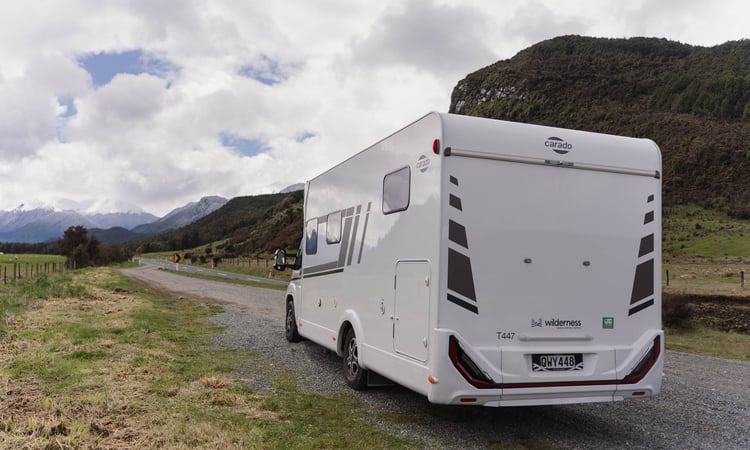
A comprehensive motorhome policy with a specialist insurer covers accidental damage to the vehicle itself, its contents, your liability to others, and emergency costs if something goes wrong on the road.
What's typically included
-
Accidental physical loss or damage to the vehicle, habitation body, and all fitted parts
-
Fire, theft, and illegal conversion (the theft or unauthorised use of your vehicle)
-
Glass cover (windscreens, sunroofs, headlights, mirrors, and perspex alternatives — see below)
-
Contents (unfixed furniture, linen, appliances, crockery — up to policy limits)
-
Emergency accommodation and travel if your motorhome becomes undriveable
-
Legal liability for damage or accidental injury you cause to others
-
Trailer cover (up to limits — varies by insurer)
-
Transit cover if your motorhome is being transported on another vehicle
Common exclusions
Motorhome insurance, like most policies, has a detailed list of exclusions. The most important ones to be aware of are:
-
Mechanical or electrical breakdown – this is not covered by standard insurance (see the MBI section below)
-
Wear and tear, depreciation, and gradual deterioration
-
Reckless driving or driving under the influence of alcohol or drugs
-
Faulty workmanship
-
Unlicensed drivers or drivers not following their licence conditions
-
Drivers under 25 (sometimes covered if disclosed to the insurer)
-
Non-accident tyre damage (punctures, cuts, bursts)
-
Pollution, contamination, water or pest damage
-
Nuclear, war, or terrorism-related losses
-
Unoccupied for more than 30 days (damage won’t be covered for a motorhome that hasn't been slept in for 30+ days, unless it's in an 'approved facility' like a paid holiday park)
-
Commercial use – hiring out your motorhome, carrying fare-paying passengers, or racing
-
Loss of use – no cover for rental vehicles, travel costs, or other costs associated with being unable to drive your motorhome
What are the most common types of damage to motorhomes?
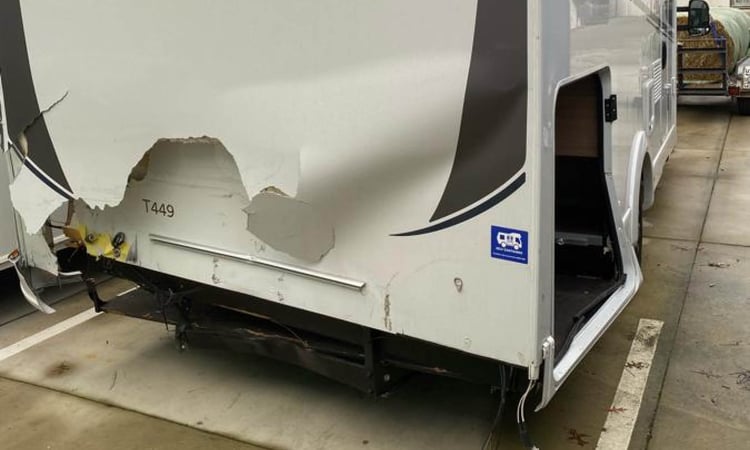
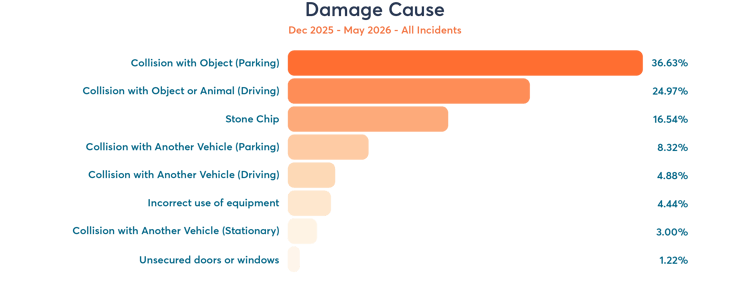
To find out the most common types of incidents, we looked at data from the Wilderness rental fleet between December 2025 – May 2026.
More than half of all recorded damage happens while parking – low-speed contact with objects, walls, posts, or other vehicles while manoeuvring and moving collisions while driving account for a further 23%. Stone chips to the windscreen are the third most common cause at 17%.
We also spoke to Covi, who said their most common claim is for glass repair.
As we head into winter, our biggest claims tend to be weather-related, particularly given the severe storms that New Zealand has experienced over the past few years. That said, our most common claim is for glass repairs.
Where does the damage most commonly happen?
The rear bumper, rear corner bottom, and rear corner top combined account for close to half of all damage recorded. The rear bumper alone – cracked, scraped, or pulled off – appears in 38% of incidents. Guests reversing into spaces they misjudge, tight campsite lanes, and the sheer size of the vehicle all contribute to the rear being the most exposed part.
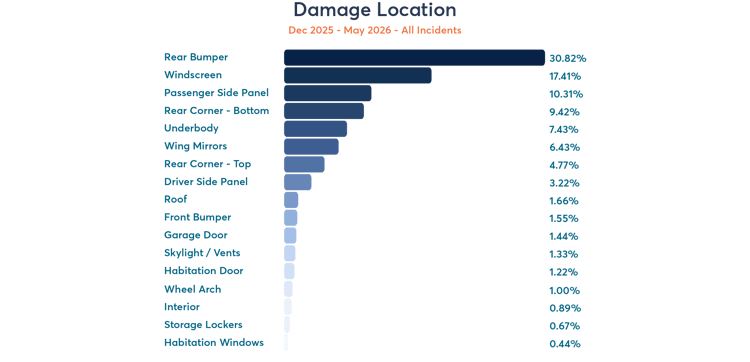
The underbody category (7.43%) is almost entirely grey water pipe damage – a recurring failure point on rough tracks, steep kerbs, or unsealed roads.
What other cover levels are available?
While comprehensive insurance is the right choice for most motorhome owners, there are some lower-cost alternatives available, which can be suitable if you're on a tighter budget or your motorhome spends long stretches parked up.
Third Party Fire, Theft & Illegal Conversion: This covers accidental loss from fire, theft or illegal conversion, plus collisions with uninsured vehicles.
Third Party Only: This is the bare minimum. It covers damage you cause to someone else's property, nothing more. It does not cover your motorhome – although some insurers will if an uninsured third party was at fault.
Storage Cover: This is for when your motorhome is parked up and not being used, offered by Star Insure only. It’s worth considering if your motorhome is in storage for extended periods, as premiums are significantly lower.
Does motorhome insurance cover towing a small car behind?
Towing a vehicle is not typically included in standard motorhome policies and generally needs separate cover for the towed vehicle. However, some insurers will cover general-use trailers up to certain limits.
Star covers trailers up to $5,000 per event under its comprehensive motorhome policy (PE44); Covi up to $1,500; AMI up to $600. Check your policy carefully – horse floats, boat trailers, and caravans are usually excluded from trailer cover.
Contents, awnings and glass cover: a closer look
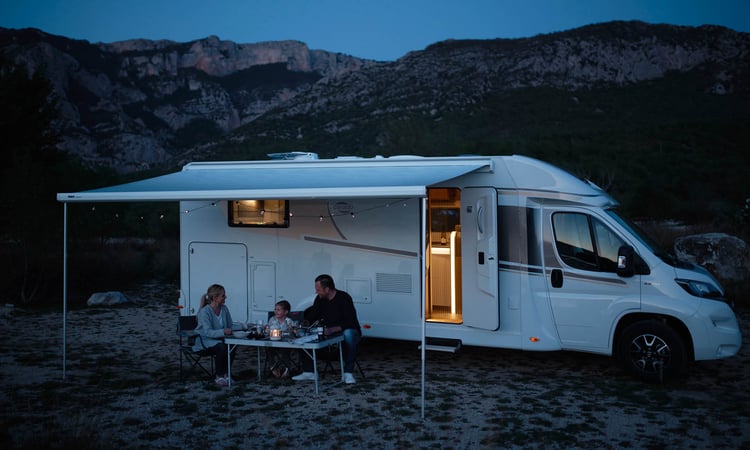
These three areas are where the gap between specialist and general insurers shows up most clearly.
Contents Cover
Only specialist insurers will cover the contents of a motorhome.
Contents cover typically includes household items and furnishings kept in your motorhome – everything from soft furnishings and kitchenware through to personal electronics, sporting equipment and bicycles. Items like jewellery and watches are generally excluded.
It's worth taking the time to list out your contents and total what it would cost to replace them, particularly if you've kitted out your motorhome with quality items. All four main providers cover replacement value, but the limits vary considerably:
-
The range runs from $2,000 to $10,000 per event across the four major providers
-
Most policies set individual limits per item – so even if your total contents cover is $5,000, a single laptop or camera might only be covered up to $1,000 or $2,000
-
If you have items worth more than the per-item maximum, get them listed separately on your policy
Awnings
Awnings are covered by Covi and Star Insure as part of their comprehensive policies, but the details matter.
Covi covers accidental loss to awnings up to 15 years old, on a sliding depreciation scale: brand new awnings are paid out at full replacement cost, scaling up to 80% depreciation for those aged 13 – 15 years. Beyond 15 years, there's no cover at all.
There's also a catch worth knowing: if you leave your awning erected and unattended for more than 48 consecutive hours, wind and storm damage won't be covered. Something to keep in mind before heading out for the day.
Star's policy works similarly – a 20% depreciation step every three years, up to a maximum of 15 years, with the same 48-hour unattended rule for wind and storm damage.
Glass cover
A shattered headlight cover or a skylight taken out by a low branch can easily amount to hundreds, or even thousands, of dollars. If your policy only covers the windscreen, you're paying for it yourself.
All four insurers offer excess-free glass cover, but the scope varies significantly between specialist and general providers.
Covi’s cover is very comprehensive, covering headlights, tail lights, mirrors, skylights, and Perspex alternatives, and it also covers bodywork scratched or damaged as a result of broken glass. Star's cover is also broader than the general insurers.
AA and AMI only cover windscreens and window glass.
This is particularly important for owners of A-class or fully-integrated motorhomes, where glass can be costly to replace. If you own a motorhome with a large panoramic windscreen or multiple skylights, the specialist cover here is worth paying attention to.
Does my insurance cover me on New Zealand's 'restricted' roads and beaches?
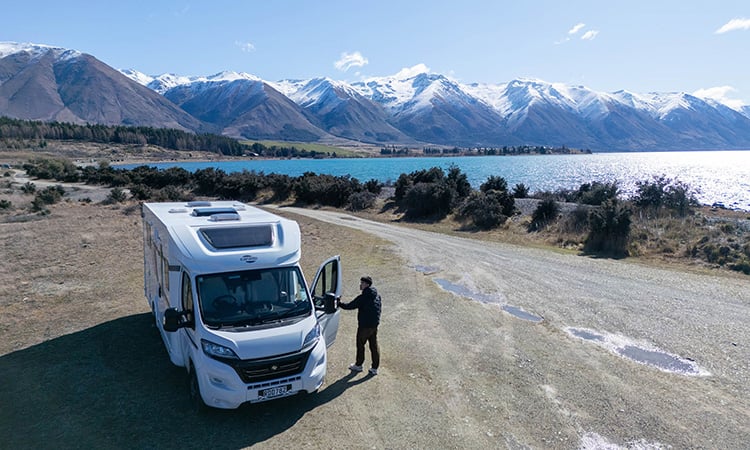
For privately owned motorhomes, the short answer is yes, with one notable exception around beaches.
This is one of the most misunderstood areas of motorhome insurance in New Zealand, largely because the rules for rental vehicles are very different from those for privately owned motorhomes.
Rental vehicles vs. private ownership
If you've ever hired a campervan, you'll know that rental companies universally prohibit three roads: Skippers Canyon Road near Queenstown, Ball Hut Road near Mount Cook, and 90 Mile Beach in Northland. Drive on any of them, and your rental cover is void.
For privately owned motorhomes, it's a different story. We’ve reviewed the current policy wordings of all four main motorhome insurers, and most of these roads aren’t specifically excluded from cover.
90 Mile Beach is the exception
90 Mile Beach is legally classified as a public highway – but it's also a beach, and AA's policy explicitly excludes driving on beaches. If you're insured with AA and you drive on 90 Mile Beach, you may find yourself without cover. Covi, Star and AMI don't include an equivalent beach exclusion in their current policy wordings.
That said, any insurer could potentially invoke broader exclusions, such as reckless driving or operating a vehicle in an unsafe condition, if circumstances warranted it. Driving into an incoming tide, for example, would be difficult to defend under any policy.
Unsealed and gravel roads
All four insurers cover New Zealand roads regardless of surface type, so long as they are legally classified as roads. There are no gravel road restrictions in any of the private motorhome policies we reviewed. Off-road and 4WD-only tracks are a different matter – these fall outside normal road use and wouldn't be covered.
How much does motorhome insurance cost?
Comprehensive premiums for a $150,000 – $300,000+ motorhome typically range from approximately $1,500 to $3,000+ per year, but individual quotes vary significantly.
The main factors that determine what you'll pay are:
-
Agreed value: The higher the insured value, the higher the premium. Specialist insurers price this more accurately than general insurers.
-
Level of cover: Comprehensive > Third Party Fire, Theft & Illegal Conversion > Third Party Only.
-
Excess: A higher excess means a lower premium. You take on more of the risk yourself.
-
Driver profile: Drivers over 25 who have held a full NZ licence for two or more years attract lower premiums.
-
Storage location: A motorhome parked on the street will carry a higher premium than one stored in a locked garage or secure facility.
-
Add-ons: Roadside assistance, contents uplift, trailer cover, and storage cover all add to the base premium.
-
Claims history: Some insurers look at claims history for up to three years prior to your new cover. If you have several previous claims, you may see a lift in premium.
Wilderness Motorhomes has found that insurers are generally reluctant to share the exact weighting of each factor.
From our own research, previous claims have a substantial impact on AA premiums, while AMI does not take them into account. Owing finance on your motorhome also nudges premiums up slightly with some providers, but makes little difference with others.
Covi and Star don't offer instant online quotes, so you’ll need to provide them with your details and have a direct conversation before they can offer a tailored quote.
How much does roadside assistance cost?
All four providers offer some form of roadside assistance, but the cost and coverage vary:
|
Provider |
Cost/year |
Key details |
|
$57.53–$87.53 per vehicle, per year |
3 callouts per year, $200–300 per callout |
|
|
Included when listed on your policy |
Unlimited callouts; towing up to $1,000 incl. GST per callout |
|
|
$80 extra per year |
No callout limit; $1,500 annual cap |
|
|
Free with comprehensive policy |
3 callouts; no cover for motorhomes over 3,500kg |
What about emergency accommodation?
This is another area to compare closely if you end up needing help further away from home. Here’s what the four main operators cover:
-
Covi: One night's accommodation if you can't get home following a covered loss; up to $700/week for up to 7 weeks temporary accommodation for full-time residents of the motorhome.
-
Star: Up to $5,000 per event for emergency accommodation and travel under the standard comprehensive policy (PE10), covering transport home, overnight accommodation up to $250 per night, and food costs up to $250 per event. An optional Temporary Accommodation extension (OE4) is available for full-time residents, covering up to $700 per week to a maximum of $10,000.
-
AMI: "Reasonable costs" for transportation, and one night’s accommodation for you, your passengers, and domestic pets, covering up to $700 per event.
-
AA: Up to $500 accommodation per claim; reasonable emergency repair costs.
How do I compare motorhome insurance policies?
The biggest differences between policies come down to how your agreed value is set, what habitation cover is included, and how claims are handled when things go wrong.
These are the areas that matter most:
-
Agreed value: How is it set? How long is it locked in for? Is an independent valuation required, or does the insurer use its own estimate?
-
Habitation cover: Does the policy explicitly cover awnings, skylights, appliances, solar panels, and water systems? Or does it treat your motorhome like a big car?
-
Glass and perspex: Does the cover extend to headlights, taillights, mirrors, and perspex alternatives? Or just the windscreen?
-
Contents limit: What's the per-event limit and the per-item limit? Is there a cap on single high-value items?
-
Emergency accommodation: How much, for how long, and is there a specific clause for full-time motorhome residents?
-
Roadside assistance: Is it included or an add-on? What are the callout limits and per-incident costs?
-
Exclusions: Read them carefully. Pay particular attention to breakdown, wear and tear, and driver age clauses.
-
Financial strength: Check the RBNZ insurer register for the financial strength rating of the underwriter. Covi is underwritten by NZI, a business division of IAG New Zealand Limited; Star is underwritten by Berkshire Hathaway Specialty Insurance (BHSI).
-
Claims reputation: Check Google and Facebook reviews, and ask fellow owners. The NZMCA forums are a good resource. Star has an almost 5-star rating from several hundred reviewers; Covi has a strong reputation, too, with fewer reviews. Both AMI and AA have solid payout reputations, earning 4 stars on Canstar.
Should I use price as the determining factor?
It can be tempting to compare policies on premiums alone, but the cheapest policy is rarely the best policy for a high-value motorhome. A $200 saving on your annual premium is quickly erased if your insurer pays out $8,000 less on a glass claim because they don't cover Perspex, or declines your awning damage because habitation items aren't in their policy wording.
The better approach is to first identify the cover you need, then find the most competitive premium for that level of cover. For most owners of premium motorhomes, that tends to point toward Covi or Star, just because specialist knowledge produces very different outcomes at claim time.
Mechanical Breakdown Insurance (MBI): Is it worth the premium for European motorhomes?
It’s definitely worth considering. A significant part of New Zealand's privately owned motorhome market originates in Europe, and standard motorhome insurance explicitly excludes mechanical and electrical breakdown.
For owners of European motorhomes, that's a particularly meaningful gap – drivetrain parts often need to be sourced from overseas, meaning repairs can be a slow process.
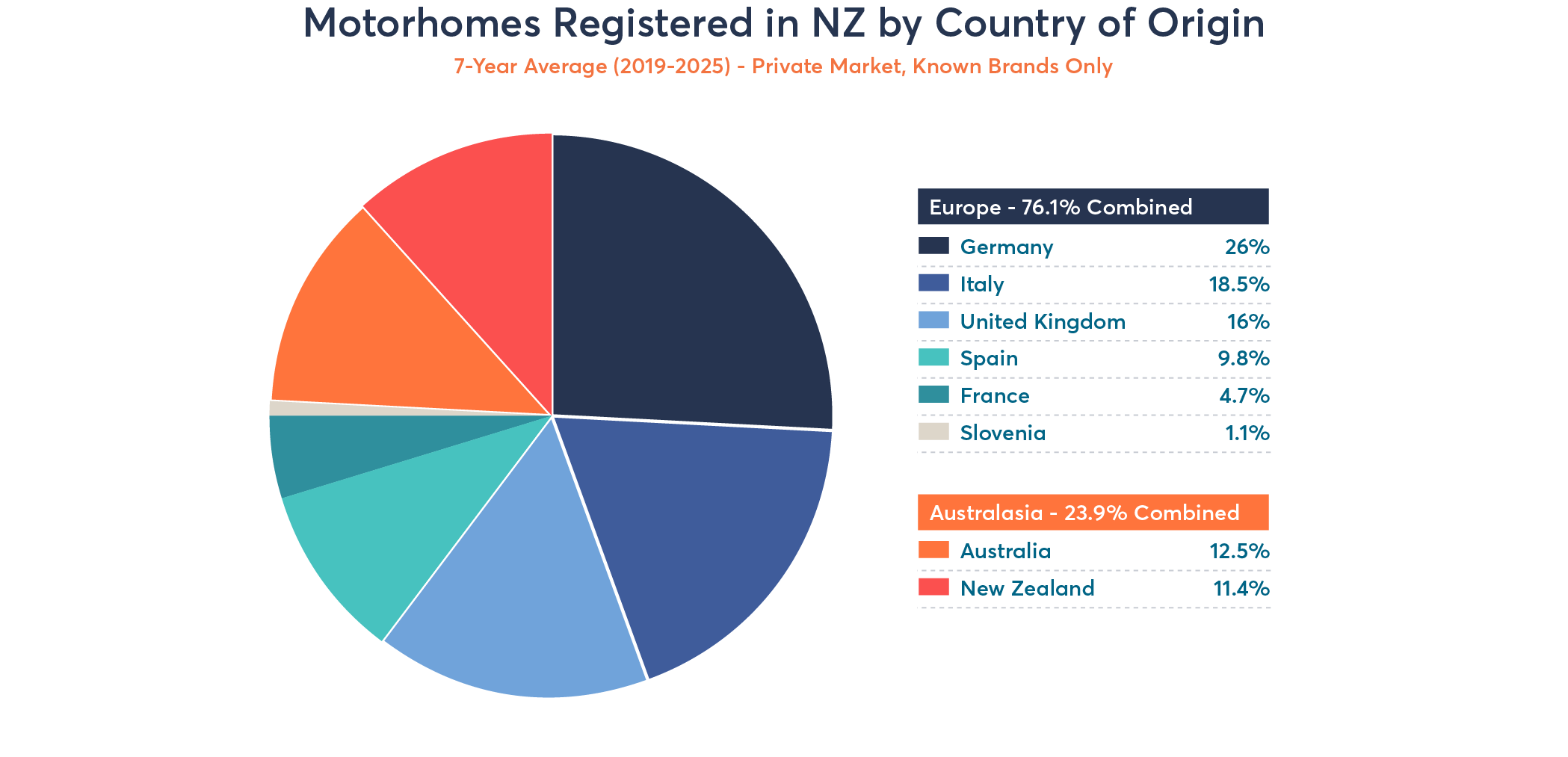
Privately owned motorhomes in New Zealand: Country of origin
Wilderness Motorhome Sales’ recent industry report, which looked at data from the NZTA Motor Vehicle Register between 2019 – 2025, found that European vehicles accounted for more than three-quarters of total RVs registered in New Zealand.
MBI covers what standard motorhome insurance does not:
-
Engine failure
-
Transmission failure
-
Electrical system faults (ECU, alternator, starter motor)
-
Air conditioning system failure
-
Cooling and fuel systems
-
Steering and suspension components
European motorhomes built on a Fiat Ducato or Mercedes Sprinter chassis use transmissions and electronics that are expensive to source and repair in New Zealand. MBI can reduce the cost of a $9,000+ transmission repair significantly.
Key MBI caveats
-
New motorhomes: If your motorhome is still under the manufacturer's warranty, MBI is redundant. Wait until the warranty period expires.
-
What it doesn't cover: Wear and tear, routine maintenance, tyres, or brakes.
-
Servicing requirements: Most MBI policies require servicing at approved intervals. Some MBI providers require more frequent servicing than the manufacturer specifies, so check this before purchasing.
-
Age and mileage limits: Most policies cap at 10–20 years old and 100,000–250,000km.


